
Reviewed · SALVADOR & PELOURINHO
Private Full-Day Tour – Salvador’s Lower & Upper City
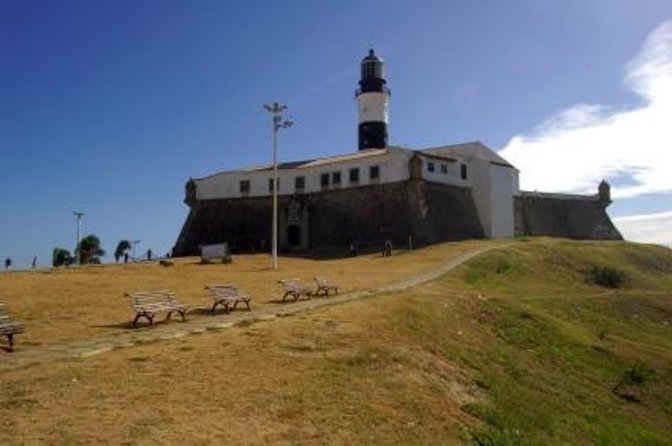
Salvador changes mood fast, from Atlantic sea breeze at Farol da Barra to church bells and old squares on the hills. I like how this day stitches together the city’s different levels, with Lower City flavor and Upper City viewpoints in one smooth route. I also love the mix of culture with real-life stops, like the classic stop for over 70 ice cream flavors at Sorveteria da Ribeira. The main drawback to plan for is that a couple of major church visits require tickets, and several stops are brief, so you will want comfy shoes and a “see it, then linger” mindset.
This is a private tour, so your guide can set the pace for your group. In the past, the guide Carlos Eduardo Barbosa has been praised for strong English and for adjusting when rain shows up or when walking is harder. You ride in an air-conditioned vehicle with bottled water, and you get a solid lunch break in the old center.
Key highlights you should not skip
- A logical Lower City to Upper City loop, so you get both the views and the historic core without feeling lost.
- Farol da Barra for Atlantic bay light, plus Dique do Tororó sculptures tied to the Orixás tradition.
- Orixá sculptures by Tati Moreno at Dique do Tororó, with a look toward Arena Fonte Nova.
- Sorveteria da Ribeira, a short detour with more than 70 regional fruit flavors.
- Bonfim ribbon ritual, with time at the church and the story behind the 8 km annual walk.
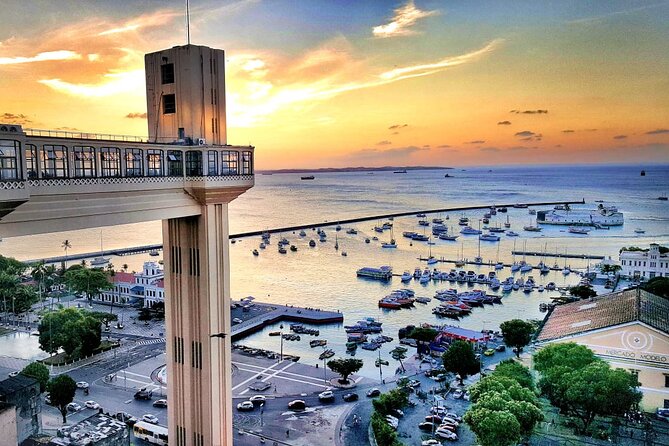
- Panoramas from high points, including Mont Serrat Fort and lookout views linked to the Lacerda Elevator area.
A full-day Lower and Upper City route that keeps the “up” part manageable
Salvador sits between sea and hills, so the big question is always the same: how do you see the whole city without spending your day climbing stairs like it is a workout video. This tour helps because it moves in a practical pattern. You start with coastal views, head toward the Lower City, then work your way back up to the higher squares and viewpoints.
You should expect lots of “quick but meaningful” stops. There are short windows at each viewpoint and landmark, usually 10 to 30 minutes. That is actually a plus if your goal is to get your bearings fast. You will likely spot things you want to revisit later, especially in the historic center around Sé, Terreiro de Jesus, and Pelourinho.
Also, the private format matters here. If you are traveling with someone who moves slower, the day can be paced accordingly. In previous tours, Carlos has been described as patient with mobility needs, including taking extra care with stairs.
More City Tours in Salvador
- Salvador City Tour – Discover Brazil’s First Capital En, It, Es
★ 5.0 · 217 reviews - Private City Tour in Salvador
★ 5.0 · 110 reviews - Afro-Brazilian Roots Private City Tour in Salvador
★ 4.7 · 88 reviews
Farol da Barra: start with ocean light and the bay entrance
The day opens at Farol da Barra, right where the Atlantic meets the bay. You get about 20 minutes here, and it is exactly the kind of first stop that makes the whole city feel real. The lighthouse area gives you a clean sense of geography: sea on one side, bay on the other, and the city’s coast curving around.
This is not a long museum-style visit. It is a “look, orient, and take photos” stop. If you are the type who likes to understand where you are before you commit to narrow streets, this start works well.
Tip for photos: plan to take a few shots of the water and coastline before you head inland. Later, you will see the bay from viewpoints above, and those views will click more in your mind.
Dique do Tororó: Orixá sculpture art and a peek toward football culture
Next you head to Dique do Tororó for about 20 minutes. The star here is the art, specifically the famous sculptures of the Orixás by artist Tati Moreno. Even if you do not know the religious background, you can still connect to what these works represent: African spiritual influence in everyday Bahia life.
You also get a practical urban moment here. The stop includes a sightline toward Arena Fonte Nova, Salvador’s major football stadium. It is not a full stadium tour, but it plants the idea that this city lives loudly through sports and music, not just churches and viewpoints.
If you care about culture and symbolism, this is a great stop. If you are only hunting for big-photo landmarks, it still works, but you may want to slow down and actually look at the sculptures rather than rushing.
Ribeira’s Sorveteria da Ribeira: a short break that tastes like Bahia
Driving down toward the Lower City, you get a scenic transition through the older financial center and the port area, then you reach Sorveteria da Ribeira for about 20 minutes. This is the tour’s “sweet stop,” but it is not random.
You have the chance to taste from 70-plus ice cream flavors, and many are made with fruits typical of the region. That is the key point for value: you are not just eating sugar. You are tasting local ingredients and flavors you might not see again once you leave Salvador.
The timing is also smart. You are not stuck searching for a place later. You get a break while you still have a long day left, so you do not feel like you are burning energy on an empty stomach.
Small reality check: ice cream itself is not listed as included, so bring cash or be ready to pay. Think of it as the tour’s “cultural snack,” not a free meal.
More Full-Day Tours in Salvador
- Full Day Tour to Frades Islands + Itaparica
★ 3.5 · 74 reviews - Full-Day Historic Private City Tour of Salvador with Lunch
★ 5.0 · 50 reviews - Private Full-Day African Oriented Salvador Upper & Lower City
★ 5.0 · 42 reviews - Praia do Forte Full Day Tour, Salvador, Bahia, Brazil
★ 4.5 · 33 reviews
Bonfim Church and the ribbon ritual you will see everywhere
At Basílica do Senhor do Bonfim, you get about 30 minutes. This is one of the most famous religious sites in Brazil, and it is tied to a tradition that spreads far beyond the walls of the church.
What you do here is simple and meaningful. You can tie the traditional colored ribbons, and you can make a wish by asking the saints for protection. The tour also frames why this matters in daily life: people from Bahia walk 8 km (5 miles) each year for the Bonfim festival.
Even if you do not personally follow the tradition, you will feel the atmosphere. The ribbons are a visual reminder that faith here is public. It shows up in public squares, on street life, and in shared rituals that families keep alive.
One consideration: some portions can be crowded when people are gathering. The 30-minute window is enough to take it in, but do not plan on a quiet, long sit-down moment.
Mont Serrat Fort and Ponta de Humaitá: panoramic views that reset your perspective
Next you move toward Ponta de Humaitá, with a stop at the Mont Serrat Fort for about 20 minutes. This is your high-point payoff before you head back into the hills.
From here, you get the panoramic feel Salvador is famous for. You are looking over the city while the ocean remains in the background. If you’ve ever felt like you need a “map in your head,” this viewpoint helps. It turns the route into something you can visualize, not just a list of stops.
It is also one of the easiest places to take a deep breath. After walking and looking at symbolism in churches, you get a wide view. That contrast makes the day feel more balanced.
Upper City squares: Thome de Souza, Lacerda Elevator views, and what you can actually see
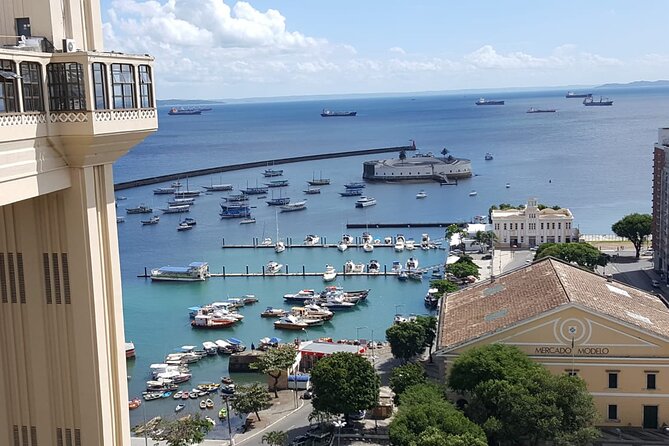
After the fort views, the tour reaches Praca Thome de Souza in the Upper City for around 20 minutes. The Portuguese built the first capital of Brazil here, and the geography feels like a hilltop acropolis even if you are not into architecture.
This stop is especially valuable because it names specific landmarks you can later point out to yourself. From the municipal area you can see the Rio Branco Palace, the City Council, and the iconic Lacerda Elevator area. You also get bay views that include the islands and the old financial district, with Mercado Modelo visible from this higher angle.
If you like “I can tell what is where now” moments, this is one. It also helps you understand why Salvador’s old city layout feels like it is layered upward, not randomly spread.
Then you pass through Sé Square for about 20 minutes. This is the location where you can still see ruins connected to Brazil’s first cathedral. Think of it as a quick history marker and photo stop. It does not replace a deeper study, but it gives context for what you are seeing later.
Terreiro de Jesus and the Cathedral Basilica of Salvador: time for lunch and sacred art
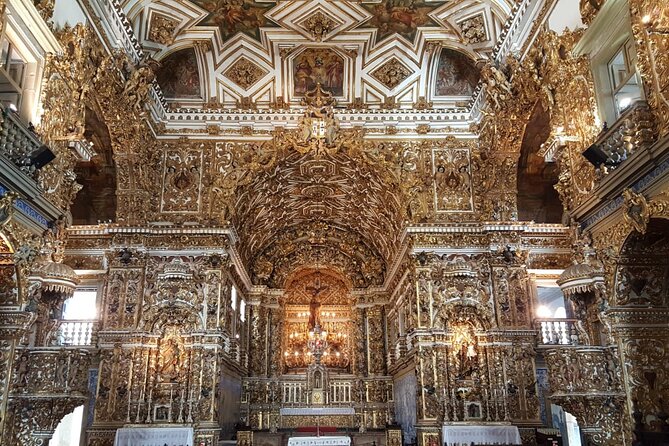
Next comes Praca Terreiro de Jesus, where you get about 1 hour. The former Jesuit school and church became the center of this area, and it now connects to the Basilica Cathedral story. The key practical feature here is that you get free time for lunch.
You do not have lunch included, so plan to use this hour to eat near the squares. Since the tour stays in the old center, this is a good moment to choose something close by and keep your buffer tight.
After lunch, you visit the Cathedral Basilica of Salvador for about 30 minutes. This is where church tickets matter. The cathedral visit has a ticket not included note, so you should expect to pay for entry if you want to go inside.
What you are looking at is described as one of Brazil’s most beautiful cathedrals, and it houses important collections of Brazilian sacred art. Even if you are not a church-expert, this stop works because you can connect art and tradition. You get a “why this city takes faith seriously” feeling in a visual way.
Pelourinho and Largo do Cruzeiro: baroque Saint Francis and identity in public spaces
The final stretch brings you deeper into the old-town landmark zone.
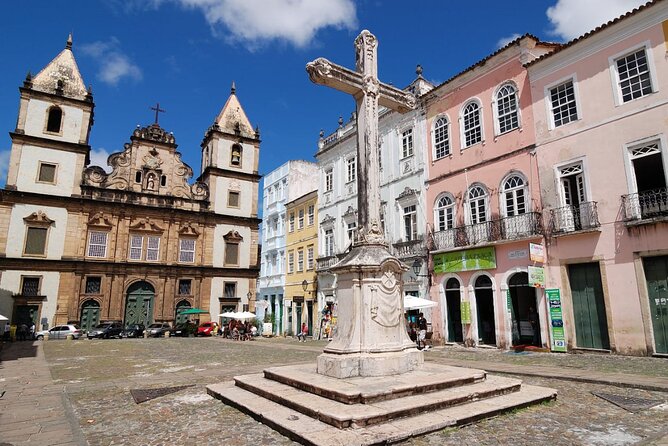
First is Largo do Cruzeiro de São Francisco for about 10 minutes. This is the heart of old city energy, with bars, restaurants, and craft shops nearby. The main focus is Saint Francis of Assisi Church, often described as a baroque highlight. Tickets are not included, so if you want to enter, bring the time and money for it.
Then you reach Largo do Pelourinho for about 20 minutes. This square is tied to key cultural institutions. You can see the Jorge Amado Foundation and the Church of Rosary of the Black Men. Even in a short stop, these names help you understand what Pelourinho represents: literature, religion, and the endurance of African roots in Salvador’s identity.
If you want a place to later return to for photos and browsing, Pelourinho is a solid choice. This tour gives you the orientation and the key landmarks.
Price and value: what $125 per person buys in real time
At $125 per person for about 7 hours, this tour is in the “pay for convenience and context” category. You are not just buying transportation. You are buying time with a guide who can connect the views, churches, and neighborhoods into a single story.
What makes the price feel more reasonable is what is included:
- a tour guide service
- an air-conditioned vehicle
- bottled water
Most of the stop points you visit are marked free admission, like Farol da Barra, Dique do Tororó, Sorveteria stop time (not the food itself), and Bonfim church access time. You only need to budget extra for the cathedral basilica and Saint Francis church entries.
So the value equation is simple. You trade your own route-planning and navigation headache for a crafted, efficient day. For many people, that is worth it, especially in a city where hills can make “just take a bus” feel harder than expected.
How to plan your day: shoes, rain gear, cash for tickets, and lunch choices
Salvador can throw weather at you. This experience requires good weather, and if it is canceled due to poor weather, you should get a different date option or a full refund. Even without cancellation, rain can slow everything down.
Practical plan:
- Wear shoes you can walk in for multiple short stops.
- Bring sun protection. The viewpoints are open.
- If rain starts, ask your guide what to do next. In past tours, umbrellas have been provided when needed.
- Bring cash for lunch and ice cream, since those are not included.
- Budget for church tickets at the Cathedral Basilica of Salvador and Saint Francis of Assisi Church, since they are not included.
Lunch is your main self-directed part. You get a free time window of about an hour at Terreiro de Jesus Square, so you can eat nearby and still stay on track.
Also, if you have mobility concerns, say so early. The guide has been described as patient and able to pace around stairs and help with movement when needed.
Who should book this private Salvador day tour, and who should not
Book this if you want:
- a private guide who can adjust the pace to your group
- a tight plan that shows both Lower City and Upper City
- a balance of ocean viewpoints, local religious traditions, and historic squares
- a day that helps you decide where to spend your free time afterward
You might skip it if:
- you want long museum-style visits at a slow pace, because many stops are intentionally short
- you dislike paying extra for church entrances, since at least two notable sites are ticket-based
- you are traveling mainly for beach time and want more relaxation than sightseeing
For families and mixed-age groups, this can work well because the route is structured and the guide can slow down where needed. The day is also flexible in practice, based on how your group feels and what interests you most.
Should you book it: my honest call
Yes, I would book this if you are short on time and want to get your bearings in Salvador without juggling transportation and guesswork. The route hits the big visual anchors, it includes culture beyond just photos, and it gives you real flavor through the Ribeira ice cream stop.
If you are the type who likes to understand the “why” behind what you see, this tour has the right ingredients: Orixá art at Dique do Tororó, Bonfim ribbon tradition at Senhor do Bonfim, bay viewpoints from high points, and public-square identity in Pelourinho.
Just go in expecting a day of short, well-placed stops, not a leisurely wandering tour. Bring comfortable shoes, budget for the cathedral and Saint Francis church tickets, and use the lunch break to recharge.
FAQ
How long is the Salvador Lower and Upper City private tour?
The tour lasts about 7 hours.
What is included in the price?
The tour includes a tour guide, an air-conditioned vehicle, and bottled water.
Is lunch included?
No. Lunch is not included, but there is free time for lunch (about 1 hour) at Terreiro de Jesus Square.
Are church tickets included?
Tickets are not included for the Cathedral Basilica of Salvador. Tickets are also not included for the Saint Francis of Assisi Church at Largo do Cruzeiro de São Francisco.
What happens if the weather is poor?
The experience requires good weather. If it is canceled due to poor weather, you will be offered a different date or a full refund.
Is this tour private?
Yes. It is a private tour, meaning only your group participates.
More of Salvador and the Pelourinho
- Round trip transfer, Salvador, Bahia, Brazil
★ 5.0 · 228 reviews - Cooking class in Salvador, an authentic dinning experience
★ 5.0 · 132 reviews - Tour to the Frades Islands and Itaparica, from Salvador – Ba
★ 4.0 · 130 reviews - Transfer Salvador Airport / Hotel Litoral Norte
★ 5.0 · 111 reviews
Newest Salvador da Bahia reviews
- Cultural Folkloric Show and Dinner in Salvador★ 4.5 · 15 reviews
- Transfer Vila Galé Marés (Guarajuba) – Private★ 5.0 · 15 reviews
- Tour to Praia do Forte and Guarajuba★ 4.0 · 16 reviews
- Private City Tour of Salvador da Bahia★ 5.0 · 17 reviews
- 3-Hour Private Tour of Salvador Capital Afro-Brazilian★ 5.0 · 17 reviews
- Afro-Brazilian Roots city Tour in Salvador with lunch at Favela★ 5.0 · 17 reviews
- Salvador African Heritage Private City Tour Including Afro Museum★ 4.5 · 18 reviews
- Morro de São Paulo Tour, Leaving Salvador-Bahia.★ 5.0 · 18 reviews
Salvador & Pelourinho, compared.


Salvador City Tour – Discover Brazil’s First Capital En, It, Es
Read our review →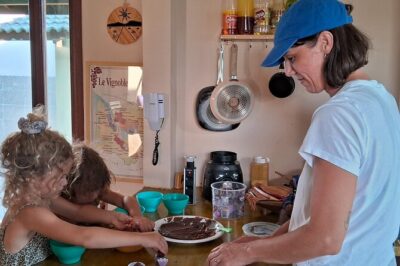
Cooking class in Salvador, an authentic dinning experience
Read our review →
Tour to the Frades Islands and Itaparica, from Salvador – Ba
Read our review →
Transfer Salvador Airport / Hotel Litoral Norte
Read our review →


Tour Praia do Forte and Guarajuba, Leaving Salvador-Bahia.
Read our review →Browse the lists this tour appears in