
Reviewed · SALVADOR & PELOURINHO
Private Anthropological City Tour of Salvador
Salvador is a city of layers, and this private anthropological tour is interesting because it ties those layers to real people, faith, and history in the same day. I love the way the route links the colonial heart of Pelourinho to today’s Afro-Brazilian culture, and I love that entrance fees and lunch are built in, so you can focus on the experience instead of budgeting each stop.
One possible drawback is the pace. It runs about 6 hours and includes walking on old-city streets plus multiple short site visits, so if you want a slow, open-ended day, you may find the schedule a bit full. Also, drinks are not included.
Key things you will notice on this tour
- A story-driven route that connects slavery-era history to living Afro-Brazilian traditions
- Multiple cultural spaces in one half-day, including a museum and Candomblé sites
- Market time with practical context, not just photos and souvenirs
- A family-style lunch included as part of the cultural experience
- Short, focused stops that keep you moving without turning every location into a long detour
How this private Afro-Brazilian focus changes your Salvador day
Most Salvador sightseeing is either beachy and scenic, or it sticks tightly to the famous postcard spots. This tour takes a different angle. You spend your time on the parts of the city where Afro-Brazilian identity, community memory, and religion are visible, and where the history behind the headlines actually shows up in everyday life.
That matters because Salvador’s culture is not an add-on. It is the main engine. The tour’s “anthropological” framing helps you understand the why, not only the what. You are not just moving between landmarks. You are following themes, such as the African roots in Brazil, the city’s slave trade history, and how Candomblé and related traditions survived, adapted, and became community anchors.
You will also feel the “private” difference. This is not a bus day where everyone gets herded on the same rhythm. Your guide can shape the pace, answer your questions, and spend a bit more time on what you care about most.
More City Tours in Salvador
- Salvador City Tour – Discover Brazil’s First Capital En, It, Es
★ 5.0 · 217 reviews - Private City Tour in Salvador
★ 5.0 · 110 reviews - Afro-Brazilian Roots Private City Tour in Salvador
★ 4.7 · 88 reviews
Price and what you actually get for $180
At $180 per person for about 6 hours, this tour is not bargain-basement pricing. But it is also not just a generic guide service. The value comes from the bundle: hotel pickup and drop-off, a driver/guide, lunch, and entrance fees across the scheduled stops.
Here’s how that usually turns into savings for you. If you tried to recreate this on your own, you would pay for transportation to scattered neighborhoods, then separately pay for museum and site access, and then still have to figure out a reliable guide who understands the cultural context. When those pieces are combined, your day is simpler.
Two notes to keep in mind. First, drinks are not included, so plan on buying water or other drinks during the meal or between stops. Second, a vegetarian option is available if you tell the operator in advance, which is a big deal for comfort and fairness at lunch.
Pelourinho: colonial squares, cobbled streets, and the story behind the stones
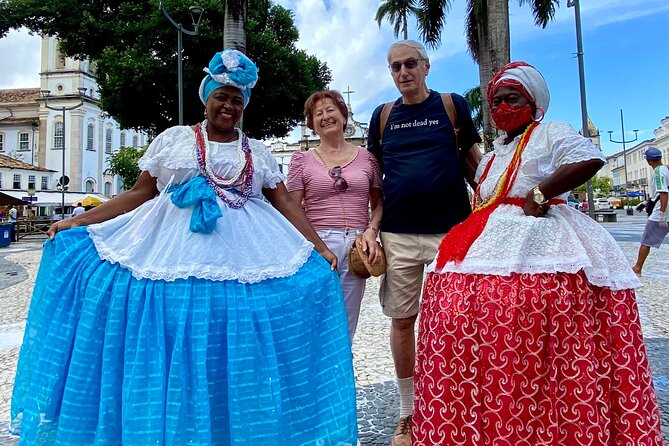
Pelourinho is the old-city centerpiece, the part many people photograph first. On this tour, it is also where you get your historical grounding. You walk around the colonial complex made up of five squares, moving through cobbled streets that still feel like you are stepping into an older Salvador.
You spend about 2 hours here, and the emphasis is on interpretation. The guide connects the architectural feel of the area to Brazil’s colonial era, and especially to the brutal dynamics of slavery and the way that history marked the city. The goal is not to make you feel bad and then move on. The goal is to help you understand how the city got shaped, and why certain spaces matter so much in the broader Afro-Brazilian story.
What can be a consideration: Pelourinho involves walking. The streets are not designed for flip-flops or long strides. If you have knee issues or hate uneven footing, wear shoes with solid grip and plan for a steady pace.
São Joaquim Market: where craft, ritual, and daily work overlap
After Pelourinho, you shift into a more active, hands-on part of Salvador: São Joaquim Fair. This stop runs about 1 hour and is described as the largest free fair in the city.
This is where the tour gets practical in a really good way. You are not only seeing colorful stalls. You are learning about the informal workforce connected to African-descended communities, and how that work ties into everyday goods as well as Afro-Brazilian ritual life.
The market is a main distributor of items like clay handicrafts and goods used for Candomblé rituals, along with products connected to the Bahia recôncavo (the surrounding region). You might spot items related to couscous and pots, plus other clay goods used for daily life and spiritual practice. Even if you do not buy much, it helps you connect culture to materials.
Because this is a free fair stop, you do not lose time paying entry. You use that hour to see how history becomes commerce, and how tradition remains practical.
More of Salvador and the Pelourinho:
- Round trip transfer, Salvador, Bahia, Brazil
★ 5.0 · 228 reviews - Cooking class in Salvador, an authentic dinning experience
★ 5.0 · 132 reviews - Tour to the Frades Islands and Itaparica, from Salvador – Ba
★ 4.0 · 130 reviews - Transfer Salvador Airport / Hotel Litoral Norte
★ 5.0 · 111 reviews
Casa do Benin and the museum approach: history through objects and meaning
Next comes Casa do Benin, an Afro museum stop. Your time here is shorter, around 20 minutes, but it is an intentional hit of context.
The museum focuses on the history of enslaved Africans in Brazil and uses representative cultural elements to help you understand artistic and ethnic aspects of African societies and their influence in Brazil. The way these displays are presented can help you connect symbols you might see later at religious sites, instead of treating them like random decoration.
Short museum stops can go two ways. They can feel rushed, or they can give you the exact anchors you need for the rest of the tour. In this itinerary, the museum functions as a bridge, so you are better prepared when you get to the more spiritual and community-based locations later.
Casa de Yemanja and Vodun Zo: moving from shoreline symbolism to living tradition
The tour then shifts toward water, coastal reverence, and religious space.
Casa de Yemanja is about a 15-minute stop at a house on the Rio Vermelho beach area, tied to Yemanjá, described as the queen of the sea in Afro-Brazilian tradition. You see an altar built in reverence to the orixá iemanjá, and the setting in a fishermen community is part of the meaning. It is easier to grasp why this divinity matters when the location matches the ocean relationship.
Then you head to Vodun Zo, where you do a walkthrough of the terreiro, a Candomblé religious community space. This stop runs about 30 minutes and focuses on religious and cultural development that originated from maroon communities, described as historical havens for enslaved Africans practicing Candomblé.
A terreiro visit is not like a standard museum room. The experience depends on the setting, local protocols, and the guide’s framing. With that said, this itinerary is structured to keep it respectful and educational, aimed at helping you understand the community side of the faith, not just observe it from the sidelines.
One practical consideration: if you are sensitive to sacred spaces or prefer not to visit religious sites, this portion may feel more personal than you expected. On the other hand, if you want your understanding to go beyond street-level tourism, these are often the stops that make the day click.
Lunch with a local family: the most human hour of the day
Lunch is a standout here. You get about 1 hour at a local family restaurant, and the tour frames it as typical food in that family setting.
This matters for your overall trip because Salvador’s food is not only flavor. It is also identity, regional technique, and community rhythm. When lunch is placed inside a family environment, you get more than a meal. You get a sense of how culture is lived.
The tour includes lunch, but drinks are not included. That means your budget for the meal is simpler, yet you still have control over what you choose to drink.
Vegetarian options are available if you request them ahead of time. If you have any dietary needs beyond that, you should share them before the tour so your lunch experience stays comfortable.
Dique de Tororó: seeing the orixás as art on the water
The final major sightseeing stop is Dique de Tororó, a lake area where you admire sculpted figures on the water that represent African gods, orixás.
This is about 20 minutes, and it is a good payoff. After walking through history and religious spaces, you end with a visual reminder of how spiritual figures and cultural memory can be expressed in public art.
It also provides a calmer moment compared to the earlier walking and dense cultural stops. Even with a schedule, a short lake or water view tends to help your brain process what you have learned that day.
If you are a photo person, this is one of your better chances to capture more than architecture. The composition of figures and water can create images that feel distinctly Salvador, not generic Brazil souvenir photos.
Guide style is the difference between seeing Salvador and understanding Salvador
This tour lives or dies by the guide, and the guiding approach here seems built for real questions. In the examples people share, guides such as Josuel Olafemi, Marcos, and Mônia are described as warm, flexible, and eager to answer questions as they come up.
That kind of responsiveness is important on a day like this. You are covering charged topics, religious spaces, and community traditions. A guide who can adjust the explanation to your interests can turn a list of stops into a coherent story.
It also helps that your guide can provide context in the moment. For instance, if something at a market connects to a later religious symbol, a good guide can point out the connection right away, so you do not need to guess.
Language can also matter. Some guides are described as fluent in English and able to switch explanations based on the situation. If you are traveling with mixed language comfort, that flexibility can make the whole day feel smoother.
Who should book this tour, and who should think twice
If you care about Afro-Brazilian culture, Candomblé, and how slavery-era history shaped the city, you will likely love this tour. It is also a great fit if you want a guided day that includes both a museum and community sites, plus a lunch that feels integrated rather than tacked on.
This is also ideal for people who like depth without drowning in lectures. The stops are varied and each one is short enough that you keep moving, but long enough for context to land.
Think twice if you:
- Want a super relaxed day with lots of free time
- Have difficulty with walking on older streets and uneven cobblestones
- Prefer purely secular sights and would rather skip religious/community spaces
If you are the kind of traveler who likes to understand why a place matters as much as what it looks like, this tour matches your style.
Should you book this private anthropological city tour of Salvador?
Book it if you want Salvador with meaning. The combination of Pelourinho context, market craft and ritual goods, Afro museum interpretation, sacred terreiro walkthrough, a family lunch, and a lakeside orixá sculpture stop creates a day that feels connected, not random.
Skip it if you only want postcard highlights or if you need a slow pace. This itinerary is built for people who enjoy walking, asking questions, and learning through places rather than just reading plaques.
If you fit the sweet spot, this tour offers strong value because it bundles access, lunch, and guidance into one smooth half-day. And that is exactly what you want when Salvador is already full of surprises.
FAQ
What is the duration of the Private Anthropological City Tour of Salvador?
The tour lasts about 6 hours.
What does the $180 price include?
The price includes hotel pickup and drop-off, the driver/guide, lunch, and entrance fees. Drinks are not included.
What stops are included in the itinerary?
The tour includes Pelourinho, São Joaquim Market, Casa do Benin, Casa de Yemanja, Vodun Zo, lunch at a local family restaurant, and Dique de Tororó.
Is lunch included, and are vegetarian options available?
Lunch is included. A vegetarian option is available if you advise the operator at booking time.
Is this a group tour or a private tour?
It is a private tour/activity, meaning only your group participates.
What is the minimum number of adults required to book?
The minimum is 2 adults per booking.
Newest Salvador da Bahia reviews
- Transfer Salvador to Barra Grande Round Trip★ 5.0 · 3 reviews
- Cruise Ship Special Private Tour Salvador da Bahia Historic Old Town Bonfim and Barra★ 5.0 · 3 reviews
- Airport Transfer-Grand Palladium Imbassai 1 to 4 people by Salvador Receptivo★ 5.0 · 3 reviews
- Exclusive Salvador City Tour with Beachtime Swim Stop★ 5.0 · 3 reviews
- Private Bike Tour Circuit Along the Beach★ 5.0 · 3 reviews
- Private Capoeira Class in Salvador★ 5.0 · 4 reviews
- Bahia By Night: Dinner and Folkloric show★ 5.0 · 4 reviews
- Candomblé: Religious,social Focus and Community visits★ 5.0 · 4 reviews
Salvador & Pelourinho, compared.


Salvador City Tour – Discover Brazil’s First Capital En, It, Es
Read our review →
Cooking class in Salvador, an authentic dinning experience
Read our review →
Tour to the Frades Islands and Itaparica, from Salvador – Ba
Read our review →
Transfer Salvador Airport / Hotel Litoral Norte
Read our review →


Tour Praia do Forte and Guarajuba, Leaving Salvador-Bahia.
Read our review →Browse the lists this tour appears in