
Reviewed · HISTORICAL TOURS IN RIO DE JANEIRO
Rio Historic Center Walking Tour with Typical Brazilian Lunch
Old Rio is a lot easier to understand on foot, because you can actually see how the city was built, rebuilt, and rebranded over time. This tour strings together cinematic landmarks in the Centro with close-up stops like the Selarón staircase and Lapa arches, plus a classic indoor coffee break and a typical Brazilian lunch to keep you fueled. The main thing to consider is that it is a walking tour through dense urban streets, so comfy shoes matter, and you’ll want to keep your pace steady.
What I like most is the way the route forces the connections to make sense: opera-house grandeur, baroque church architecture, repurposed spaces, and street art all in one loop. I also like that you get a guide who can explain what you’re seeing in plain language, and even the reviews call out a French guide named Antoine living in Rio for about eight years. The only possible drawback is time, you cover a lot of territory in about five hours, so you won’t linger for long photo marathons at every corner.
Key highlights you can count on
- A focused Centro route that connects major squares, cathedrals, and viewpoints without wasting time
- Selarón staircase plus Lapa aqueduct arches, street-level art and 18th-century water engineering
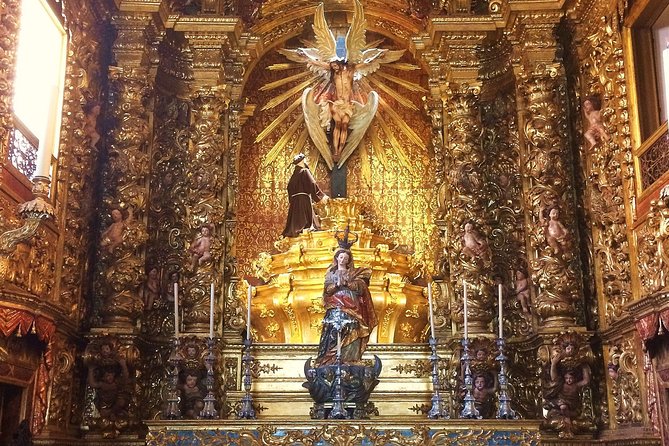
- Monumental stained glass and baroque churches around Largo da Carioca, with terrace views
- Confeitaria Colombo stop in the pedestrian streets, for a classic Centro feel
- Eduardo Kobra’s Kobra mural and a return by Olympic-era tram
- Lunch included, so you’re not hunting for food mid-walk
A 9:00 am Centro loop that covers the essentials in 5 hours
This is a small-group walking tour with a maximum of 12 people, and that matters more than you might think. In a big crowd, you lose track of what’s important. Here, you get enough breathing space to hear the explanations and still move efficiently between stops.
You start at Copacabana Palace, A Belmond Hotel on Av. Atlântica at 9:00 am. The itinerary is built like a line you can follow, with frequent short stops around landmarks rather than one huge museum session. It ends back at the meeting point, so you’re not stranded in the middle of your sightseeing.
And since most admissions are free on the stops listed, your money goes mostly toward the guide and the overall route. The one clear paid element is that you get typical Brazilian lunch included near the end, which helps the day feel complete instead of like you’re just walking for hours.
More Historical Tours in Rio de Janeiro
- Rio de Janeiro Historical Center Walking Tour
★ 4.5 · 336 reviews - Private Walking and Cultural Tour Rocinha-Rio de Janeiro
★ 5.0 · 239 reviews - Discover Rio Little Africa: A Cultural and Historical Journey
★ 5.0 · 238 reviews
Cinelandia’s grand squares, where Rio shows its opera-house side
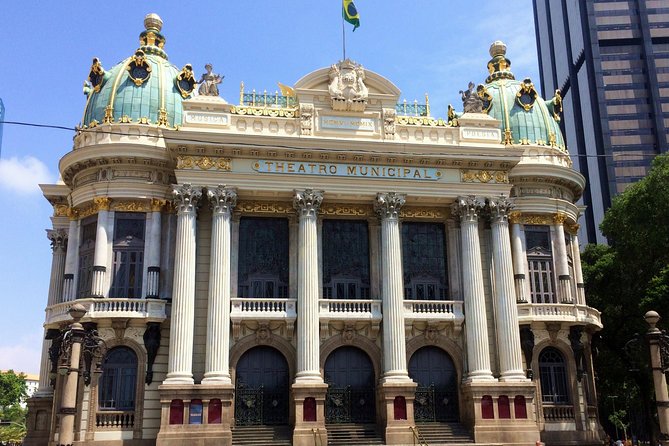
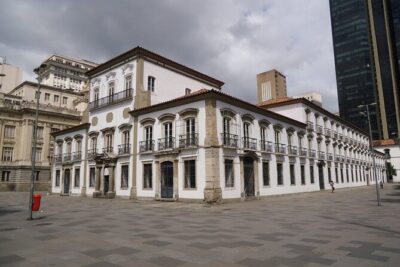
You begin in Cinelandia, the kind of square where Rio wants to show you it had ambitions long before tourism made it famous. Expect a guided presentation of the main attractions clustered around the plaza: Teatro Municipal (the Rio opera house), Museu das Bellas Artes, the Câmara Municipal, the Biblioteca Nacional, and Teatro Odeon. The tour also points out that Teatro Odeon is the only cinema in the square still operating.
What I like about starting here is the contrast it gives you. Before you hit the street art and aqueduct area, you get a feel for the city’s formal face, the civic and cultural power buildings that define much of Rio’s Centro.
Time here is short, about 20 minutes, so it’s more orientation than deep lecture. Use it to spot details for later photos. Even if you only remember one thing, remember how the Centro layout starts to connect: squares, grand facades, then the walkability shifts into neighborhood texture.
Selarón staircase to the Lapa aqueduct arches: art plus engineering in one walk
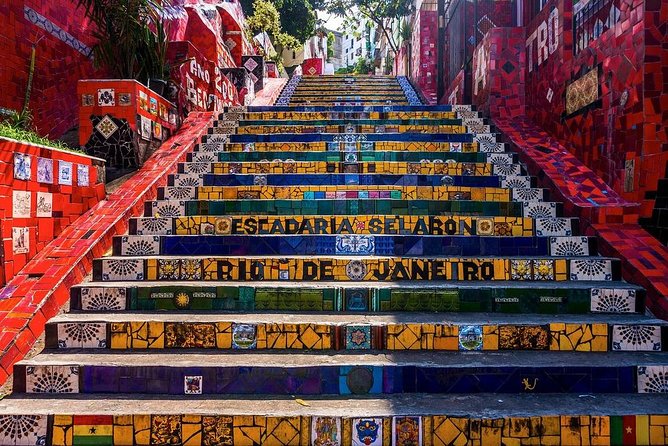
Next comes the jump from Santa Teresa down toward Lapa at the base of the hill. The key stop is the Escadaria Selarón, the multicolored staircase created by Chilean artist Jorge Selarón over about twenty years. You’re looking at a landmark that works like a public scrapbook. It’s not just pretty steps, it’s Rio at street level, where personal expression becomes community architecture.
You’ll also notice how the guide frames it: the staircase isn’t isolated. It’s a gateway into the wider Lapa area, where walls, tracks, and buildings get reused and decorated. If you’re the type who likes cities that feel lived-in rather than staged, this stop is a big reason to book.
From there, you reach Arcos da Lapa, the old Rio aqueduct arches dating from the 18th century, which supplied water to the city until the end of the 19th century. This part is surprisingly educational. The aqueduct gives you a different kind of “historic center” story, one about infrastructure, not just monuments.
And yes, you’ll see plenty of graffiti in the surrounding district. The mix is the point. Lapa is where old infrastructure and modern street art share the same walls, so the neighborhood feels like it has layers rather than one fixed era.
Metropolitan Cathedral and Largo da Carioca terraces: monumental glass and baroque closeness
After Lapa, the tour shifts back toward religious and architectural drama. The Metropolitan Cathedral of Saint Sebastian is a quick indoor stop, about 15 minutes, focused on architecture, history, and its monumental stained glass windows. Even with limited time, you get the best part of a cathedral visit: the big visual moments explained in context, not just a look-and-go.
Then you move to Largo da Carioca, about 25 minutes, where two churches sit close enough to experience as a pair: the São Antônio church and São Francisco da Penitência, described as one of Brazil’s most beautiful baroque churches. You’ll also get a panoramic view from the terrace area where the churches are next to each other.
This terrace-view portion is why I think this tour works so well for first-timers. Walking tours often give you history but not perspective. Here, you get the view that helps you understand how dense Centro is, and how the squares fit into the bigger city picture.
A small practical tip: churches can mean different lighting than the street. If you care about photos, keep your settings ready and don’t rush the indoor windows. Even short time inside can still reward a calm pace.
More Walking Tours in Rio de Janeiro
- Rio de Janeiro: Rocinha Favela Walking Tour with Local Guide
★ 4.8 · 3,052 reviews - Rio De Janeiro: Half-Day Rocinha Favela Walking Tour
★ 4.7 · 2,272 reviews - 3 Hour Rocinha Favela Walking Tour with a Local Guide
★ 5.0 · 833 reviews - Favela Tour Rio de Janeiro – Vidigal Walking Tour by Russo Guide
★ 5.0 · 377 reviews
Confeitaria Colombo and Praça Quinze: Centro’s classic café and the big river links
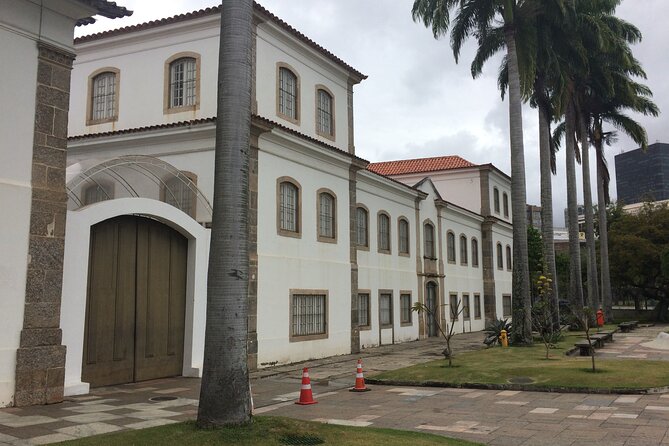
At around the middle of the walk, you head through pedestrian streets to Confeitaria Colombo, an older Rio café with an art deco style that’s treated as an iconic Centro stop. The tour keeps it brief, roughly 10 minutes, and it’s labeled as a free-admission stop, so think of it as a culture pause rather than a long meal.
I like this kind of stop because it breaks the rhythm. After churches and aqueducts, you need a human-scale moment. Even if you just enjoy a drink, Confeitaria Colombo helps you feel what old Rio daily life might have been like, not only what it looked like in textbooks.
Then you continue to Praça Quinze de Novembro, about 20 minutes. This is tied to the proclamation of the Republic, and the guided walk covers major landmarks around the square: the Igreja de Nossa Senhora do Carmo (Church of Our Lady of the Carmelites), Paço Imperial, the Equestrian Statue of General Osório, Tax Island, and the ferry pier connections to Niterói and Paquetá Island across Guanabara Bay.
This stop is worth your attention because it turns your walk into a geography lesson. You’ll see how Centro connects to the bay, and how those water routes matter to Rio’s identity. The square gives you the sense that the city is always negotiating land and water.
Praça Pio X to Mosteiro de São Bento: churches, cultural institutions, and atmosphere

Next is Praça Pio X, about 15 minutes, where you’ll pass key points like Candelária Church and the Olympic boulevard, along with cultural stops such as the Centro Cultural do Banco do Brasil and Casa França-Brasil.
This isn’t a deep dive into any one building, but it’s a smart “orientation through landmarks” move. You start to recognize Centro’s repeating rhythm: church, civic buildings, cultural spaces, and public areas where people actually cross paths.
Then the tour heads to Mosteiro de São Bento (Saint Benoit monastery), also about 15 minutes. It’s presented as one of the most beautiful churches in Rio to visit. Even in a short window, the guide’s job here is to help you notice what makes a monastery church feel different from a cathedral. If you’ve ever had trouble sorting religious architecture in your head, a focused explanation is what saves your memory.
Mauá Square, Museu de Amanhã area, and the Kobra mural you don’t want to miss
The walk continues to Mauá Square, about 20 minutes, a cultural zone where Museu de Amanhã (Museum of Tomorrow) is nearby. The tour does not enter the museum, but it points out its architectural interest and pairs it with nearby views.
You’ll also hear about the Art Museum of Rio and its panoramic terrace. The idea here is simple: you’re walking all morning, and now you get a payoff view where landmarks beyond Centro come into focus. From the terrace area, the viewpoint includes things like Niterói Bridge and the Museu de Amanhã area, giving you a sense of scale across Guanabara Bay.
Then comes one of the most Instagram-friendly stops on the route, but it’s more than a photo moment. At Etnias – Mural de Graffiti in the Estúdio Kobra area, you’ll see the mural described as the largest in the world. It represents five ethnic groups and was produced by artist Eduardo Kobra for the Olympic Games. This is a stop that turns street art into public storytelling.
The mural also helps you understand the tour’s theme. Rio’s historic center is not frozen. It has old arches, working streets, and brand-new public art all coexisting, and the guide’s framing makes that clear.
Santo Cristo return by Olympic-era tram, then lunch back in Cinelandia
After the Kobra mural, you’ll take a tram from in front of it to return toward Cinelandia, and the tour notes that this tram was built by Alsthom for the Olympic Games. That little transit detail is a neat bridge between Rio’s past and its modern staging, and it helps you recover after the walking-heavy middle of the tour.
The final piece is the typical Brazilian lunch, included as part of the experience near the end back around Cinelandia with the guide. Even without a menu described, the value is clear: you’re not left to guess where to eat in the Centro chaos. You get a planned meal that fits the route, and it gives you a chance to ask more questions when the day’s fresh.
Price, group size, and whether this is good value
At $126.15 per person for about 5 hours, this tour isn’t the cheapest way to see Centro. But it stacks up as good value if you care about context, not just checklists.
Here’s why:
- You’re paying for a guided walk that covers a lot of landmark types in one morning, from opera-house squares to aqueduct arches.
- The group size stays small, max 12 travelers, which usually means more direct explanations and less “walk and hope” sightseeing.
- Most stops have free admission listed for the attractions you’re viewing, so your spending isn’t eaten up by ticket lines.
- Lunch is included, which matters in a place where finding something reliable quickly can cost time you do not have.
If you want a guided day that helps you recognize what you’re seeing, this is a smart spend. If you prefer self-guided wandering with zero structure and lots of detours, you may find it tight.
Who I think it suits best: first-timers who want a solid Rio foundation, couples or small groups who like walking, and anyone who enjoys architecture plus street art rather than choosing one lane. It also fits travelers who hate museum days but still want real historical grounding.
Should you book this Rio Historic Center walking tour?
Yes, I’d book it if you want Centro to make sense fast. This route is built for learning without feeling like school: squares with major institutions, street art that tells a story, churches that reward attention, and a planned lunch that keeps you moving without stress.
Skip it only if you already know you dislike walking through dense city blocks, or if you need long stops to process each site. The tour is paced for coverage, not for lingering.
If you’re choosing one morning to get oriented in Rio de Janeiro’s historic core, this is one of the cleaner, more structured options that still feels local and human.
FAQ
What time does the tour start?
The tour starts at 9:00 am.
Where do I meet the guide?
The meeting point is Copacabana Palace, A Belmond Hotel, Av. Atlântica, 1702, Copacabana, Rio de Janeiro.
How long is the tour?
It lasts about 5 hours.
What is the group size?
The maximum group size is 12 travelers.
Is lunch included?
Yes. A typical Brazilian lunch is included.
Are admission tickets required for the stops?
Most stops listed have free admission. One stop includes admission, and lunch is included as well.
Where does the tour end?
The tour ends back at the meeting point.
Is this tour near public transportation?
Yes, it is described as near public transportation.
What is the cancellation policy?
The experience is non-refundable and cannot be changed for any reason.
What happens if the minimum number of travelers is not met?
If it’s canceled because the minimum isn’t met, you’ll be offered a different date or a full refund.
Newest Rio de Janeiro reviews
- Maracanã Matchday Tour – Ticket + Guide + Transfer★ 5.0 · 14 reviews
- Angra & Ilha Grande From Rio: Boat Tour With Barbecue and Drinks★ 5.0 · 14 reviews
- Private Tour with Churrasco in Vela Catamaran – Velas do Rio★ 5.0 · 14 reviews
- Half-Day Private Tour:Rio de Janeiro Highlights by Bernard Moraes★ 5.0 · 14 reviews
- Tijuca Forest Adventure★ 4.5 · 14 reviews
- Rio de Janeiro: Join a Fluminense game at Maracanã with locals★ 5.0 · 15 reviews
- Rio de Janeiro: Join a Botafogo soccer game with transport★ 5.0 · 15 reviews
- Christ the Redeemer, Selaron Steps and Santa Teresa Half-day Tour★ 4.5 · 15 reviews
Historical Tours in Rio de Janeiro, compared.

Private Walking and Cultural Tour Rocinha-Rio de Janeiro
Read our review →
Discover Rio Little Africa: A Cultural and Historical Journey
Read our review →
Rio Gastronomy: Culture & History Through The Art Of Food – Walking Group Tour
Read our review →
Adventure & History at Tijuca Forest (small group or private)
Read our review →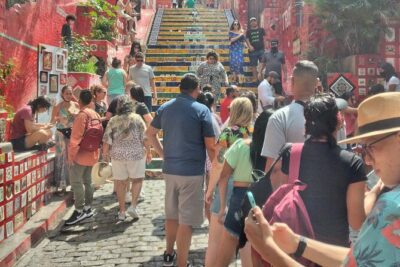
From the Past to the Present: A Historical Walking Tour of Rio
Read our review →Browse the lists this tour appears in