
Reviewed · HISTORICAL TOURS IN RIO DE JANEIRO
Historical Rio Walking Tour
Rio’s downtown can feel like two cities at once, European and Brazilian, official and everyday, all layered on the same blocks. This tour turns that blur into a clear route with a small group and a guided metro ride to get you oriented fast. The main downside to keep in mind is simple: it is a walking-and-standing circuit, so if you have limited mobility or get worn out quickly, this won’t be your easiest option.
I like that the route is built around big names you can picture, Municipal Theatre, National Library, Tiradentes Palace, Paço Imperial, then backs it up with real-world context from the guide. If you get Senora Lu, Matilde, or Leonardo, you are likely to get that mix of sharp detail and an upbeat, practical feel that makes the architecture and politics stick. Since food and drinks are not included, plan your own snack strategy.
Key Highlights That Make This Downtown Tour Work
- Subway start from Copacabana to the city core so you spend less time guessing and more time seeing.
- Cinelândia Station and French architectural influence gives you a quick theme for the day.
- Municipal Theatre details from 1909 like gilded mirrors, stained glass, murals, and sparkling chandeliers.
- Paço Imperial’s long life as viceroys, the monarchy, post and telegraph, and today a cultural center with free access.
- Cultural stops beyond monuments like Centro Cultural Correios and CCBB, where the city’s arts scene shows up in historic buildings.
- Small group, focused attention with time for questions, and even a break for coffee and pastry when it makes sense.
Starting at Copacabana, then riding the subway like a carioca
The day begins at the entrance of the Belmond Copacabana Palace Hotel. From there, you take the subway downtown, with a stop at Cinelândia Station. It is a smart way to start because it gets you moving toward the historic center without wasting your energy on long taxi rides or slow first-time navigation.
This route also matters because it is not just a photo walk. The guide uses the ride as part of the story, like teaching you the city’s rhythm before you hit the landmarks.
You will be out about 4 hours total, ending back at the meeting point. That pacing is ideal if you want a concentrated overview without turning the day into a full marathon.
More Historical Tours in Rio de Janeiro
- Rio de Janeiro Historical Center Walking Tour
★ 4.5 · 336 reviews - Private Walking and Cultural Tour Rocinha-Rio de Janeiro
★ 5.0 · 239 reviews - Discover Rio Little Africa: A Cultural and Historical Journey
★ 5.0 · 238 reviews
Cinelândia Station: a relic of French influence you can stand on
Cinelândia Station is where the vibe changes. You spend time at a station described as a relic of French Architectural influence in Brazil, tied to the early 1900s look of the area. Even if you do not read architecture, you can feel why that matters, because it sets up what you are about to see across the boulevard and squares.
From the start, your guide frames what you are looking at. You stop often enough to actually connect details to the broader theme, instead of just passing by and hoping it clicks.
Practical note: you should still budget stamina here. Subway time is easy, but then the walk begins, and the center is active.
The French Renaissance-style building and the art mix inside the story
One of the early highlights is a French Renaissance-style building associated with a notable art collection. You get a description of paintings by Brazil’s finest contemporary artists, plus an array of folk and African art.
I like this kind of stop because it stops the tour from becoming only about marble and power. Brazil’s downtown includes art that is shaped by local culture and history, and this is the moment where the tour makes that explicit.
You will likely appreciate this stop most if you enjoy seeing how museums and galleries show up in the middle of “official” neighborhoods. It is a reminder that culture was never meant to live only in separate buildings.
Municipal Theatre (1909): gilded mirrors, stained glass, and real theater glamour
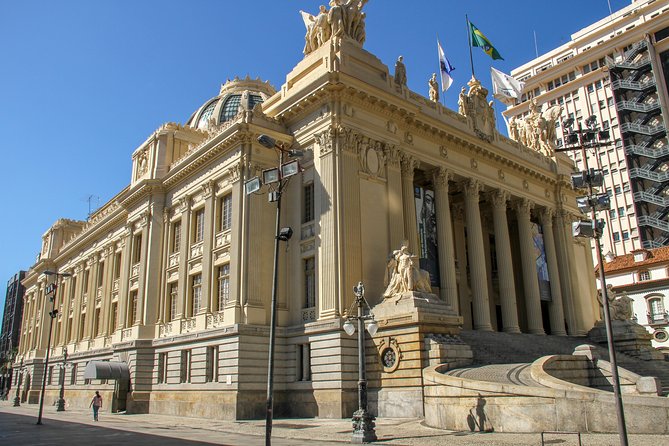
The route then reaches the Municipal Theatre, tied to the city’s Opera House era from 1909. This is the kind of place where you can understand why people get excited, even if you are not a theater fanatic.
The details your guide points out are the selling points: gilded mirrors, statues, murals, stained-glass windows, and sparkling chandeliers. It is all the visual language of importance and spectacle, designed to communicate, in a literal way, that culture belongs at the center of public life.
A consideration: this is one of the busiest-feeling stops in many city centers. If crowds make you anxious, take your time for the best views, then move on. The tour’s structure helps, because you do not get stuck here forever.
More Walking Tours in Rio de Janeiro
- Rio de Janeiro: Rocinha Favela Walking Tour with Local Guide
★ 4.8 · 3,052 reviews - Rio De Janeiro: Half-Day Rocinha Favela Walking Tour
★ 4.7 · 2,272 reviews - 3 Hour Rocinha Favela Walking Tour with a Local Guide
★ 5.0 · 833 reviews - Favela Tour Rio de Janeiro – Vidigal Walking Tour by Russo Guide
★ 5.0 · 377 reviews
National Library: where Rio connects to Brazil’s documented memory
Next comes the National Library, described as the depository of Brazil’s bibliographical and documentary heritage. It is also noted as being considered by UNESCO as the seventh largest national library in the world, and the largest library in Latin America.
What I like about this stop is how it changes your reading of the day. Before this, the emphasis is on buildings and beauty. Here, your guide helps you see that these landmarks are part of how nations preserve identity, knowledge, and continuity.
If you love learning about institutions, this is a strong mid-tour moment. If you are more into street-level scenes, it still pays off because it anchors the route in something bigger than sightseeing.
Pedro Ernesto Palace: symmetry, staircase drama, and a key civic ensemble
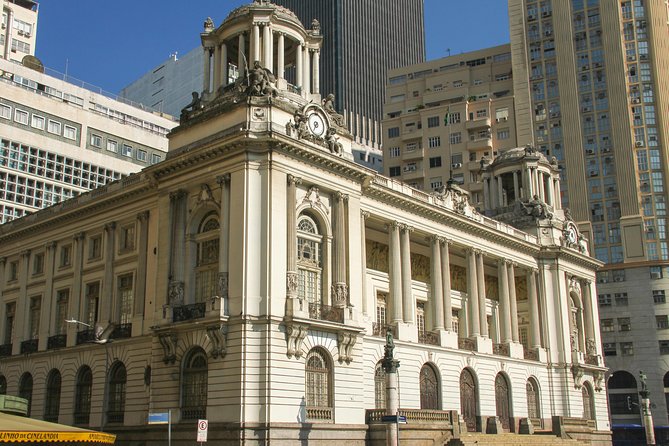
You move on to Pedro Ernesto Palace, now housing the City Council of the municipality. The description focuses on why it belongs in an architectural ensemble, calling out the perfectly symmetrical facade, rich details, an access staircase, an upper gallery with double columns, and two “tempiettos” at the corners.
This is one of those stops where the guide’s commentary turns stone into information. You start to notice how the building’s layout communicates hierarchy and order. You also see why civic power in Rio is not just a government concept, it is an aesthetic one.
If you like walking tours that teach you how to “read” a building, you will appreciate this more than a quick exterior photo stop.
Cultural Center of Federal Justice and the idea of culture as access
After the civic palace, the tour shifts into an institutional culture space: the Cultural Center of the Federal Justice. The idea here is spelled out clearly, it is a known space that incentivizes and ensures access to multiple ways of cultural expression.
You are told it hosts exhibitions, dance and music shows, courses, seminars, lectures, and other events. I like this stop because it makes culture feel practical. It is not just about heritage sites, it is about what the city actually does today with public buildings.
It is also a good palate cleanser after the heavier political architecture. You get a sense of civic life as something active and ongoing.
Tiradentes Palace: from National Congress past to State Legislative present
The route then reaches Tiradentes Palace. The description calls out Corinthian columns and an eclectic style that draws attention from the street.
Your guide also frames its role in government history. It was the former seat of the Brazilian National Congress between 1926 and 1960, and today it is the seat of the State Legislative Assembly.
This is where the tour earns its name as a historical route. You are not just looking at a pretty facade. You are getting a timeline of power, and how one building can shift roles as Brazil changes.
If your interest is politics through architecture, this stop will hit the mark. If you prefer stories about daily life more than governance, just let the guide connect the dots. It does.
Praça XV and the Golden Law moment you can picture
In the Praça XV area, the tour becomes a mix of squares, churches, fountains, and national turning points. The location context matters here: it sits between Estação das Barcas (boats leave for Niterói), Rua 1º de Março, Arco do Teles, and Paço Imperial.
A key detail your guide points out is the fountain of Mestre Valentim, inaugurated in 1789, but noted as deactivated. There is also the Church of Our Lady of Monte do Carmo in the square.
Then you get the national memory moment: in 1888, the square was the scene of celebrations tied to the Golden Law, signed by Princess Isabel, who extinguished slavery in the country. This is one of the tour’s most emotionally weighted stops because it anchors a major historical change to an exact public space.
Practical tip: public squares mean more wind and more standing. Take a breath, hydrate if you can, and let the guide set the scene before you move on.
Paço Imperial: built for governors, later monarchy, then post and telegraph
Paço Imperial is one of the strongest stops on the route because it has a long, clearly explained timeline. The building is described as a colonial structure built in the 18th century, used as the residence of governors of the Captaincy of Rio de Janeiro. It later became home to King Dom João VI and also to emperors of Brazil.
After the Proclamation of the Republic, the post and telegraph were located here. In 1938, it was listed by National Historical and Artistic Heritage, and since 1985 it has been a cultural center linked to the National Historical and Artistic Heritage Institute. The best part for your planning, it has free entrance all year round.
Even if you only see the exterior during the tour, the value is that you understand why the building keeps mattering. It shows how one location can shift from administration to monarchy to communications, all without losing its identity.
If you want to extend the day, this is the stop you could come back to later, because it is free to enter anytime.
Centro Cultural Correios and the Rio 92 story inside an eclectic building
Centro Cultural Correios is where the tour adds a modern layer to historic space. The building is described as eclectic style with early 20th-century lines. It was built to host the Brazilian Lloyd school, but that did not happen, and it became an administrative and operational post building for more than 50 years.
Then comes a clear transformation story: in the 1980s it was disabled for reform, reopened on July 2, 1992, and partly renovated to receive Exposição Ecológica 92, tied to the UN conference environment calendar, called RIO 92.
The official inauguration happened in August of the following year with Filatelia-Brasiliana-93. Since then, Centro Cultural Correios has hosted events across multiple areas, including theater, video, music, and arts, with a focus on integrating cariocas through different forms of artistic expression.
This stop is valuable because it helps you understand Rio downtown is not frozen in time. The city reuses its old structures for new cultural purposes, and this building is a clean example of that pattern.
Travessa do Comércio: a car-free alley network that still feels colonial
After the big names, you get a quieter, street-level feel at Travessa do Comércio, near Praça XV. The tour suggests crossing the alleys and alleys that form the area, and notes that the street is closed to car traffic.
The key takeaway is that it preserves traits of colonial times. I like this kind of detour because it breaks the monument rhythm. It also gives you a sense of how people might have moved through the center before cars changed the streets.
If you want at least one moment that feels less like a lecture and more like exploring, this is the part to slow down and look.
CCBB and a final architecture-and-faith pairing near the center
The tour includes CCBB, the Centro Cultural Banco do Brasil. You are told what the center includes: exhibition rooms, three theaters, a library, cinema, and a video room. It is housed in an art deco style building in what used to be the financial district.
This is another “culture in historic walls” stop, and it reinforces the theme that downtown Rio is not just about past glory. It is about institutions that keep running.
Then the route finishes this stage with the Church of Our Lady of Candelaria, described as a Catholic temple and one of the main religious monuments of the city. It is also noted as a traditional stage of weddings of Carioca society.
That wedding detail is unexpectedly practical. It tells you the church is not only about tourism, it is about life events. So even late in the tour, you are not only seeing history, you are seeing how tradition still shows up in modern Rio.
How the 4 hours usually feel, and where your guide adds the most value
The pacing here tends to work because it mixes metro orientation with a walking loop that hits major anchors, then returns to smaller connective spaces like alleys and squares.
Your guide is the real engine of the experience. In reviews, the standout theme is the human touch. One guide, Senora Lu, was praised for being both knowledgeable and fun, with lots of time for questions, including how history connects to everyday life.
Matilde was praised for answering questions and also for being considerate about taking a coffee and pastry break. Leonardo was praised for being friendly, knowledgeable, and passionate, and for navigating the downtown streets from churches to monuments and giving a lot of context about the people and history of Rio and Brazil.
Even without knowing the exact guide you will get, you can plan to use your Q&A time well. Bring the questions you actually have, like what to focus on when you come back on your own, or why one building seems more ornate than another.
One more thought: the tour is described as not recommended for people with walking difficulties, and it asks for moderate physical fitness. If you can handle a steady walking pace and occasional standing, you will likely enjoy the full arc.
Price and value: why $74.50 fits this route
At $74.50 per person for about 4 hours, the value comes from three things you get together:
First, you get a professional guide who stays with you through multiple landmark clusters. Second, you get transportation support via the subway downtown, including a stop at Cinelândia Station. Third, there is an explicit note that the Cinelândia Station admission ticket is free.
What is not included is also important. Food and drinks are not included, so you should budget for water and a snack, or plan to grab something nearby after the tour. Since one review specifically mentioned a coffee and pastry break, you can think of it as the kind of thing your guide might suggest, but you should not assume it is built in.
As a planning detail, this tour is often booked ahead, with an average of 46 days in advance. If you are traveling at peak times, book sooner rather than later.
Should you book this Historical Rio downtown walking tour?
Yes, book it if you want a guided, logic-based route through Rio’s historic center, starting from Copacabana and including a real subway ride. You will get the big-ticket architecture moments like Municipal Theatre and National Library, then balances them with civic buildings, cultural centers, and squares where history happened in public space.
Skip it if your walking stamina is limited, or if you want a purely relaxed, no-standing sightseeing style. This is a “walk and learn” format. Also remember that food is not included, so plan a snack stop in advance if you have a strict schedule.
If you like history told through buildings and streets, and you want small-group attention, this is a strong way to get your bearings in downtown Rio fast.
FAQ
How long is the Historical Rio Walking Tour?
It runs for about 4 hours.
Where do I meet the guide, and when does it start?
You meet at the entrance of the Belmond Copacabana Palace Hotel in Copacabana, and the tour starts at 10:00 am.
What transportation is included?
The tour includes a subway ride downtown, with a stop at Cinelândia Station.
What is included in the price, and what is not?
The price includes a professional guide. Food and drinks, as well as hotel pickup and drop-off, are not included.
Is this tour good for people with walking difficulties?
It is not recommended for people with walking difficulties, and it asks for moderate physical fitness. Comfortable shoes are recommended.
Can I cancel if the weather is bad or if plans change?
If canceled due to poor weather, you are offered an alternative date. The tour also allows free cancellation up to 24 hours in advance for a full refund.
Newest Rio de Janeiro reviews
- Maracanã Matchday Tour – Ticket + Guide + Transfer★ 5.0 · 14 reviews
- Angra & Ilha Grande From Rio: Boat Tour With Barbecue and Drinks★ 5.0 · 14 reviews
- Private Tour with Churrasco in Vela Catamaran – Velas do Rio★ 5.0 · 14 reviews
- Half-Day Private Tour:Rio de Janeiro Highlights by Bernard Moraes★ 5.0 · 14 reviews
- Tijuca Forest Adventure★ 4.5 · 14 reviews
- Rio de Janeiro: Join a Fluminense game at Maracanã with locals★ 5.0 · 15 reviews
- Rio de Janeiro: Join a Botafogo soccer game with transport★ 5.0 · 15 reviews
- Christ the Redeemer, Selaron Steps and Santa Teresa Half-day Tour★ 4.5 · 15 reviews
Historical Tours in Rio de Janeiro, compared.

Private Walking and Cultural Tour Rocinha-Rio de Janeiro
Read our review →
Discover Rio Little Africa: A Cultural and Historical Journey
Read our review →
Rio Gastronomy: Culture & History Through The Art Of Food – Walking Group Tour
Read our review →
Adventure & History at Tijuca Forest (small group or private)
Read our review →
From the Past to the Present: A Historical Walking Tour of Rio
Read our review →Browse the lists this tour appears in