Reviewed · SãO PAULO HIGHLIGHTS
Walking Tour São Paulo Center: Historical Process Of The Largest City in Brazil
Walking São Paulo’s center is interesting because the city grew in layers, not all at once. You start at the early Jesuit mission site, then keep moving through cathedral squares, law school politics, merchant and banking buildings, and finally the skyline era. It is a smart way to get your bearings fast.
I love that this is a private tour for just your group, so you are not stuck waiting for slow walkers or fighting crowds. I also love that you get a licensed English-speaking guide, which matters here, because the details are what turn landmarks into real stories.
One consideration: it is still a walking route through very active streets, including the busy area around Sé Cathedral. If your legs fatigue easily, plan your pace with the guide and wear comfortable shoes.
Key things to know before you go
- Private for your group means you can move at a pace that fits you, with less crowd friction.
- English-speaking licensed guide helps you connect the religious, legal, and financial threads of the city.
- Farol Santander observation deck included gives you a 360º perspective without extra ticket hassle.
- Many stops have free admission (and the tour time stays focused on seeing, not ticket lines).
- 3 to 4 hours on foot is ideal for a first visit or a history-focused afternoon.
- Ends at Theatro Municipal near metro stations Anhangabaú and Patriarca on the red line, after a coffee break.
Walking São Paulo’s Center, Where the City Learns to Speak
This tour is built like a timeline you can walk through. You do not just look at pretty buildings. You see how São Paulo’s power shifted over centuries, from the mission school era to law and politics, then business and finance, and finally the early skyscraper ambition.
You will also learn how the city’s identity sits in plain sight. The Sé Square area marks the city center, so the cathedral and surrounding streets are not just architecture, they are the everyday stage where São Paulo happens.
For me, the best part is that you get context while you are still standing in front of the place. That makes it much easier to remember what you saw later when you are choosing where to eat, which neighborhood to explore next, or what view to chase on your own.
More City Tours in São Paulo
- São Paulo’s Full Day City Tour: Main City Sights in 7 Hours – (Shared Group)
★ 5.0 · 1,691 reviews - São Paulo: Main City Sights in 7 Hours – Shared Group Tour
★ 4.9 · 587 reviews - São Paulo: City Highlights Guided Tour
★ 4.5 · 307 reviews
Price and value, what the $99 really covers
At $99 per person for a 3 to 4 hour private walking tour, the value comes from three places.
First, you are paying for a licensed bilingual guide who can explain what you are looking at. In a historic center where buildings blend into a modern city, that guide layer can save you hours of guessing.
Second, the tour includes the Farol Santander observation deck ticket. You are also getting entry included for that stop while many other sites on the route have free admission.
Third, your time stays efficient. The itinerary is arranged as short stops that add up, so you maximize sightseeing without turning your afternoon into a paperwork marathon.
If you like planning ahead, note that the average booking lead time is about 53 days. That tells me this is a popular format, so if your dates are fixed, lock it in early.
Stop 1: Pateo do Colégio, São Paulo’s founding story in one place
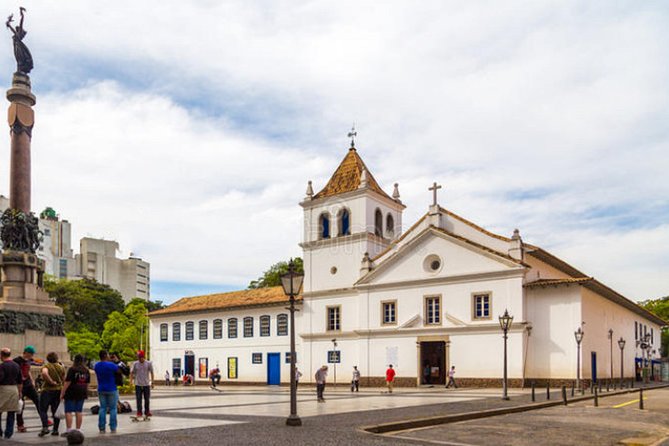
You start at Largo Páteo do Colégio, the historic founding site tied to the early Jesuit presence in São Paulo. Here, the story goes back to the mission school that aimed to teach and catechize local inhabitants.
This is the kind of opening stop that pays off later. After you hear how the Jesuits established a foothold with education, you start noticing how the city’s institutions kept forming around learning, authority, and influence.
The museum portion and the visit time is about 20 minutes, and admission is free. That works well as a warm-up. You get a strong starting point, then you are off into the city’s other big themes.
Stop 2: The Manor of the Marquesa of Santos, power and people
Next up is the Manor of the Marquesa of Santos, a residence connected to Domitila de Castro Canto, known as the Marquesa de Santos. The manor dates to the latter part of the 18th century and ties the city’s rise to key figures who shaped its momentum.
This stop is brief, around 5 minutes, but it is a useful pivot. The tour shifts from mission-era beginnings into the idea that São Paulo’s growth also depended on households, social status, and the people who connected the region to larger national events.
Admission is free, so you spend your time understanding the significance instead of budgeting for tickets.
More Historical Tours in São Paulo
- São Paulo: Downtown Historical Bike Tour
★ 4.9 · 191 reviews - Sao Paulo: Downtown-Center History Walking Tour – in English
★ 5.0 · 91 reviews - Gastronomic Tour São Paulo – Culture & History Through The Art Of Food – Private
★ 5.0 · 50 reviews - Full Day Private Beach Tour Santos – Culture, History & Beach (Pickup São Paulo)
★ 5.0 · 47 reviews
Stop 3: Image House and Alley Pinto, small stops that add up
Then you move to the Image House and Alley Pinto, part of the Museum of the City of São Paulo through historic building No 1. This is a three-story 17th-century residence, and it is one of the thirteen historic buildings included in the city museum circuit.
This stop is only about 5 minutes, so think of it as a “texture” stop. When the tour moves quickly, small details help you understand that the historic center is not one landmark, it is a neighborhood of layers.
If you enjoy street-level history, you will like that the guide points out what to notice even in a short visit.
Stop 4: Sé Cathedral, medieval style at the city’s ground center
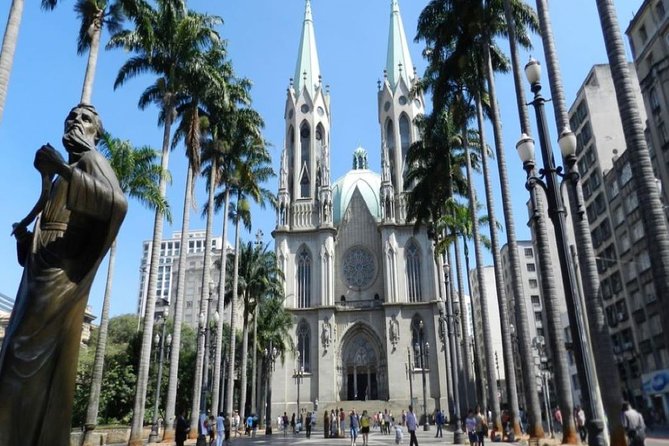
Sé Cathedral is next, with about 20 minutes on site. The cathedral’s design takes inspiration from medieval European churches, and it sits in the center of São Paulo’s historic map, at Sé Square, commonly treated as the ground zero of the city.
This is one of the moments where you can feel how “public” São Paulo is. The area is very busy, so keep your awareness up and stay close to your guide.
What I like about this stop is that the cathedral is not only religious architecture. It is also an anchor for the city’s layout and daily movement. You can almost see how the city grew around it, literally and socially.
Admission is free, which keeps the stop focused on walking, looking, and listening.
Stop 5: Largo São Francisco Law School, where movements learned strategy
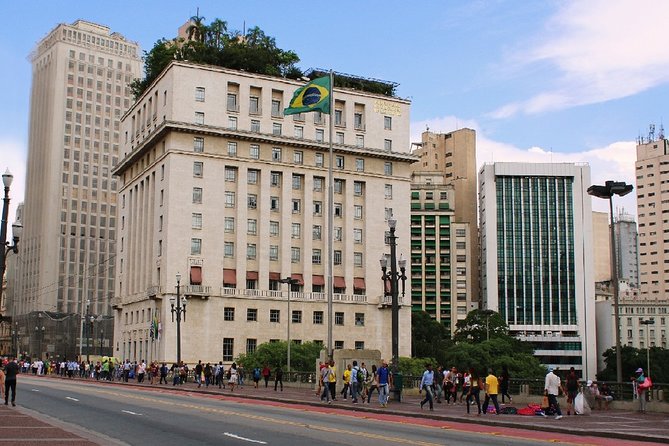
From Sé, the route heads to the Law School at Largo São Francisco, with about 10 minutes here. The big idea is that this school became a launchpad for major Brazilian movements, from abolitionism to the republican movement.
It also connects to later political history, including the campaign for direct elections during the military government in the 1980s, known as diretas já. The tour ties this to how students and graduates shaped national events, including presidents, governors, mayors, and other public figures.
This stop is short, but it gives you a mental framework for what you might see later. In São Paulo, education is not just campuses and degrees. It is a pipeline into public life.
Admission is free. The guide makes it easy to link the building to the political influence it carried.
Stop 6: FECAP in Liberdade, business education with a long paper trail
Now you shift from political education to economic training at FECAP, Fundação Escola de Comércio Álvares Penteado, in the Liberdade area. The stop lasts about 5 minutes, and admission is free.
The standout facts are historical and specific: FECAP holds the oldest public utility certification in Brazil since 1915. The institution also began courses in economics in 1934 and accounting in 1939.
I like this stop because it gives you balance. If your head is full of kings and churches, it is easy to miss the administrative side of how a city functions. Business education helped turn São Paulo’s momentum into systems people could run.
Even if you only take in the quick overview here, the guide’s framing helps you see why financial centers and trade schools matter in city growth.
Stop 7: Centro Cultural Banco do Brasil, culture inside a 1901 neoclassical building
Next is the Centro Cultural Banco do Brasil. The stop is about 15 minutes, and admission is free.
You are looking at a 1901 building with five floors, designed in neoclassical architecture. The cultural center includes cinema, theater, and an auditorium, plus spaces like a store and coffee shop. It is also a place for exhibitions.
This is a nice break in the density of older institutional buildings. It reminds you that historic centers do not freeze in time. They get reused, repurposed, and kept alive through public culture.
If you like to pause and absorb, this stop gives you a little breathing room before the tour pivots again toward finance and height.
Stop 8 and 9: B3 and then Farol Santander for the 360º view
First comes B3, the bolsa do Brasil, which is São Paulo’s stock exchange. The stop is about 5 minutes, and admission is free. Even in a short stop, it helps you understand why the center kept transforming into a place where money and decision-making concentrate.
Then you head to Farol Santander, with about 30 minutes included. This is the skyline reward. You get access to the observation deck with a 360º view of São Paulo.
This is one of those “payoff” moments. You walk all morning through streets with specific historical purposes, and then you look out and see the modern city layout. From up there, you can better grasp distances and how neighborhoods connect.
Because the observation deck ticket is included, you do not need to plan an extra purchase or time sink.
Stop 10 to 12: Martinelli, São Bento, and a Mussolini-era architect’s civic building
Martinelli Building is next, with about 10 minutes. It is known as the first skyscraper in Latin America, and its construction caused controversy because building that tall was new for its time.
You then move to Mosteiro de São Bento, the San Benedictine Monastery, around 10 minutes. This stop works for religious and non-religious visitors. It connects sacred space with everyday traditions. You can also see the historic note that Pope Benedict XVI hosted here during his visit to Brazil.
A fun practical detail: the monastery has a shop where you can find breads, cakes, cookies, and jams made by the monks using long-established recipes. It is a small sensory reminder that history here is not only in walls, it is in habits.
Finally, you reach Matarazzo Building, the city hall of São Paulo, with about 10 minutes. It was inaugurated in 1939 for a major industrial conglomerate, the Matarazzo Industries. The building was designed by Marcello Piacentini, described here as the favorite architect of Benito Mussolini.
I like this trio because it shows three angles of the same theme: ambition in the sky, continuity in spiritual tradition, and the civic face of industry.
All three stops have free entry.
Stop 13 to 15: Sampaio Moreira, Viaduto do Chá, and Anhangabaú’s political square
Edificio Sampaio Moreira is next, about 5 minutes. It has 12 floors and stands about 50 meters high, making it the tallest building in São Paulo between 1924 and 1929, before the Martinelli building opened. It is described as one of the first major examples of its type in the city and in the country.
After that, you visit Viaduto do Chá, with about 15 minutes. It is one of São Paulo’s postcard structures, the Tea Viaduct, named because there were extensive tea plantations nearby.
Then you come to Vale do Anhangabau, about 10 minutes. This is a historical meeting point for cultural and political demonstrations. A key reference point here is diretas já, the direct elections movement during the military government.
This sequence is clever because it links physical structures to historical uses. A viaduct is not just a bridge. It hints at trade. A valley is not just a view spot. It is where political pressure was made visible.
Admission stays free for these stops.
Stop 16 and 17: Shopping Light and the Theatro Municipal, power and art meet at the end
Shopping Light takes about 10 minutes, admission free. The building was inaugurated in 1929 and served as headquarters for a Canadian company responsible for electric power service in São Paulo from 1899 to 1981. It is a reminder that utilities and infrastructure helped shape the city’s modern form.
Then you reach Theatro Municipal de São Paulo, with about 20 minutes. This is considered a postcard stop, and it is one of the most important cultural locations in town. A key highlight connected to this theater is the Week of Modern Art in 1922, a major event in Brazil’s cultural timeline.
This is also where the tour ends. The tour wraps up after a coffee break near the Municipal Theater, close to the subway stations Anhangabaú and Patriarca on the red line. That is handy because you can keep exploring immediately after your coffee, without hunting for transportation.
How to pace a 3 to 4 hour walking history tour
This tour is designed around shorter visits, not long museum sessions. That suits most travelers who want a solid first look at the city without losing the afternoon to lines or sitting too long indoors.
Still, you should plan for walking in a busy historic center. Wear comfortable shoes, keep an eye on where the guide is leading, and consider carrying water. If your group includes anyone with mobility limits, your private format can help you set a realistic pace.
One of the best things about the private setup is that guides can tailor the flow a bit to your interests and energy level. I’ve seen this kind of customization work well when people want more architectural detail or prefer more time for photos and viewpoints.
And because the tour ends near the red line, you also avoid getting stuck far from transit after a long walk.
Should you book this walking tour of São Paulo’s center?
I think this is a great choice if you are:
- Visiting São Paulo for the first time and want to understand how the center became powerful.
- Interested in the connection between religion, law, business, and architecture.
- Short on time and want an efficient 3 to 4 hour format.
- Someone who values an English-speaking, licensed guide to translate the city for you in real time.
I would skip it if you are the type who wants only one deep museum stop per day or you hate walking through busy areas. This is a walking tour, so the style fits best when you enjoy moving and looking.
One more practical plus: guides on this tour have earned strong praise for being friendly, helpful, and flexible. For example, Marcio is repeatedly described as friendly and helpful, and Carla is highlighted for being fun, accommodating, and skilled with language. That kind of guide energy makes the whole route feel smoother.
If your goal is to leave São Paulo’s center with a clear mental map and a sense of how the city grew, this is the kind of tour that earns its $99 price tag.
FAQ
How long is the Walking Tour São Paulo Center?
It lasts about 3 to 4 hours.
What does the $99 price include?
The tour includes a professional licensed bilingual (English) guide and entry for the Farol Santander observation deck.
Is it a group tour or private?
It is a private tour/activity, with only your group participating.
Where does the tour start and end?
It starts at Largo Páteo do Colégio in São Paulo’s Centro Histórico. It ends at Theatro Municipal de São Paulo, after a coffee break near the Municipal Theater.
Is the guide English-speaking?
Yes. The tour includes an English-speaking guide.
Are admission tickets included for the stops?
Most stops list free admission, and the Farol Santander observation deck ticket is included.
Is food included?
No. Meals and drinks are not included, and the tour ends after a coffee break at the Municipal Theater area.
More of São Paulo
- Skydive Tandem – São Paulo – Brazil
★ 5.0 · 1,840 reviews - 5-hour Private Tour Of São Paulo With Its Main Sights – Optional Airport Pickup
★ 5.0 · 643 reviews - 6-Hour Classic Half-Day Private Tour of São Paulo – Optional Airport Pickup
★ 5.0 · 441 reviews - Amazing São Paulo overview in 4 or 5 hours with a private guide
★ 5.0 · 290 reviews
More Walking Tours in São Paulo
- Sao Paulo: Downtown-Center Walking Tour | 2 Hours – English
★ 4.9 · 84 reviews - Ecological walk in sao paulo
★ 5.0 · 61 reviews - Night Walking Tour through the Bars of São Paulo
★ 5.0 · 51 reviews - Free Walking Tour – São Paulo History in the city center
★ 5.0 · 42 reviews
Newest São Paulo reviews
- Private Tour: Santos & Guarujá Beaches (8H) – São Paulo Pickup★ 4.5 · 15 reviews
- Body Massage – by Venus’ Secret Spa – Sao Paulo★ 5.0 · 15 reviews
- Private Arrival Transfer: Guarulhos International Airport★ 4.5 · 15 reviews
- Taxi from Guarulhos airport to São Paulo capital★ 5.0 · 15 reviews
- Historical and Cultural Tour of the Center DE São Paulo★ 5.0 · 16 reviews
- São Paulo Coffee Tour: Farm, Culture & Lunch Included – 6h★ 4.5 · 16 reviews
- Private Half-Day Tour of São Paulo Highlights★ 5.0 · 17 reviews
- Private Transfer São Paulo Airport to Hotels with Quick City Tour★ 5.0 · 17 reviews
São Paulo Highlights, compared.

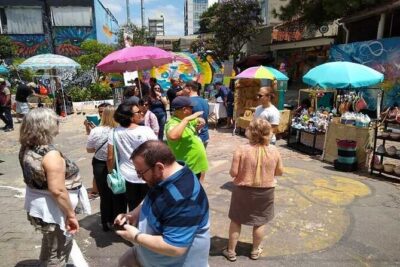
São Paulo’s Full Day City Tour: Main City Sights in 7 Hours – (Shared Group)
Read our review →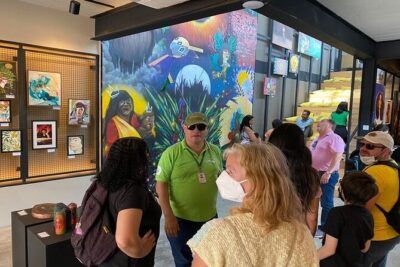
5-hour Private Tour Of São Paulo With Its Main Sights – Optional Airport Pickup
Read our review →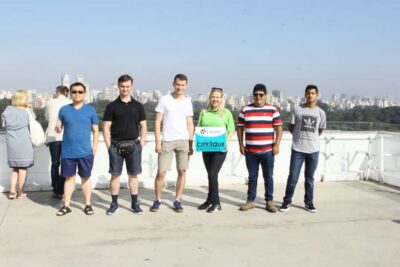
Main City Sights in 7 Hours – Shared Group Tour
Read our review →
6-Hour Classic Half-Day Private Tour of São Paulo – Optional Airport Pickup
Read our review →
Amazing São Paulo overview in 4 or 5 hours with a private guide
Read our review →