
Reviewed · SãO PAULO HIGHLIGHTS
São Paulo Uptown Bike Tour
A night bike tour through São Paulo is interesting because you get city scale fast, without getting stuck in traffic. I especially like the mix of major landmarks and quieter neighborhoods, plus the fact that you’re riding with a real guide who keeps the route practical. One thing to consider is the city has hills, and your comfort will depend on the kind of bike you’re given.
I also love that the stops are designed for quick, high-impact viewing, not long museum marathons. You’ll hit places like Catedral da Sé and the cultural stretch along Avenida Paulista, then slide toward downtown. The only drawback is that windy weather can mess with timing, so bring layers and expect to flex the pace.
Key things to know before you go
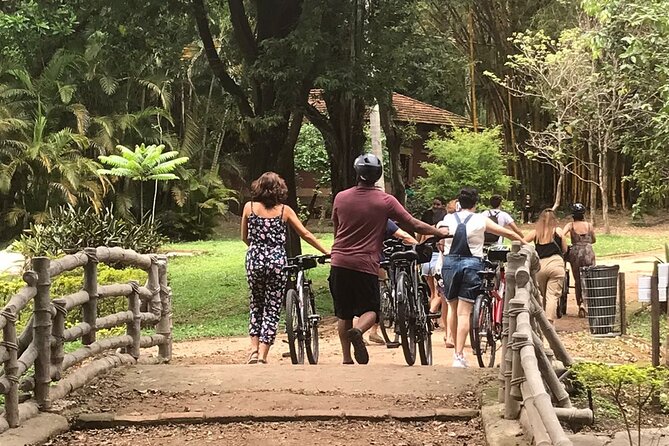
- Night ride with a guide to help you stay oriented and ride safer streets
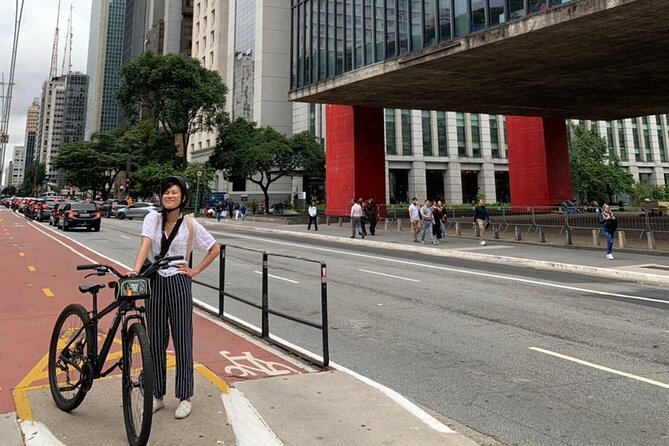
- Paulista-to-downtown route built for seeing a lot in 2 to 4 hours
- Landmarks plus neighborhoods, including Liberdade and Vila Itororó
- Culture stops with free admission listed for each scheduled site
- Caipirinha toast at the end, included with the experience
- Small group size (max 10), so you can actually ask questions and move together
A Night Bike Tour That Connects Paulista to Downtown Fast
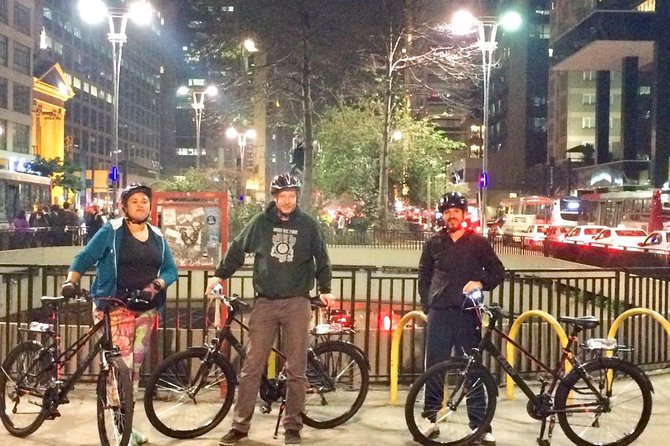
São Paulo can feel like a puzzle with too many pieces. This tour helps you put them in place by riding a route that starts on Avenida Paulista and works toward downtown, all at night. That timing matters. At night, the big avenues feel less intimidating because you’re not starting from a cold daytime rush, and you get a better sense of how the city moves after dark.
I like that the tour is built around short stops, each designed to give you a specific payoff: one landmark, one neighborhood vibe, one cultural moment. The guide’s job is to connect those points into something you can actually remember. In the small-group format, you also get more attention than you would on a larger bus tour.
There is one practical catch. Riding at night does not make hills disappear. So if you’re sensitive to steep climbs or you’re not sure you’ll keep steady power, ask your operator what bike setup will be used and plan accordingly. One rider even suggested an electric bike because the steep sections can be a lot by the afternoon.
More Cycling Tours in São Paulo
- Secrets of Downtown São Paulo Bike Tour
★ 5.0 · 240 reviews - São Paulo: Downtown Historical Bike Tour
★ 4.9 · 191 reviews - Street Art and Park Bike Tour
★ 5.0 · 56 reviews
Price and What Your $95 Really Buys
At $95 per person for 2 to 4 hours, you’re paying for more than simple transportation. You’re paying for a guide-led plan, a route from Paulista Avenue toward downtown, and access to a set of sites where the listed admission is free for visitors. That means your money goes toward experience and interpretation, not ticket fees.
You also get a built-in “end-of-ride reward.” The tour includes a caipirinha at the end, provided after the ride. That’s not just a party detail. It’s a neat way to close the loop, especially when you’ve been on bikes for hours and your brain wants a soft landing.
Value-wise, the tour also stays efficient because it’s capped at a maximum of 10 travelers. Smaller groups usually mean fewer delays at each stop and less time waiting around. You still get the big-city feel of São Paulo, but with smoother pacing.
Where to Start: Portinha 183R and How to Plan Your Arrival
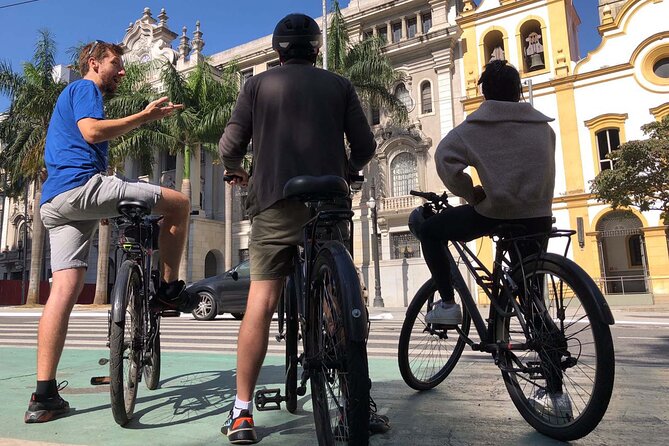
Your meeting point is Portinha 183R, França Pinto, 183, Vila Mariana, São Paulo, SP 04016-001. Since this is a night tour, arrival time matters. You want to get there early enough to meet the group, get your bike sorted, and feel ready before you roll.
One rider shared that the coffee stop where you leave and return is a real plus. If you arrive with time to spare, you may be able to enjoy coffee, tea, juice, and pastries at the place you meet. It’s a good energy reset before the ride, and it makes the beginning feel less rushed.
Also, watch the weather forecast. The tour operates in all weather conditions, so dress appropriately. Even if the rain is light, night wind can make you feel colder on the bike. Layers help, especially when you stop and start.
Catedral da Sé: Neo-Gothic Grandeur and a “Ground Zero” Feeling
The first stop is Catedral da Sé de São Paulo. This is one of those sights that instantly tells you what kind of city you’re in. The current cathedral traces back to earlier work: the first version was installed in 1591, then construction began on today’s cathedral in 1913. It opened in 1954, and notably, it opened without the main towers.
The design is neo-Gothic, and it’s described as one of the five largest neo-Gothic temples in the world. That scale is a big part of the appeal when you’re riding at night. You get to see the shape and massing clearly, and the guide can point out details you would otherwise miss while just walking past.
There’s also a political layer. The cathedral’s importance includes its role in the country’s political life. And if you’re the type who likes a deeper texture, the crypt is open to visitors. The tour mentions a feeling of arriving at the city’s Ground Zero, which is a useful mindset for orientation. You can treat this stop as a landmark that anchors everything else you’ll see tonight.
Time is short here, around 10 minutes for the stop, with the admission ticket listed as free.
More of São Paulo:
- Skydive Tandem – São Paulo – Brazil
★ 5.0 · 1,840 reviews - São Paulo’s Full Day City Tour: Main City Sights in 7 Hours – (Shared Group)
★ 5.0 · 1,691 reviews - 5-hour Private Tour Of São Paulo With Its Main Sights – Optional Airport Pickup
★ 5.0 · 643 reviews - São Paulo: Main City Sights in 7 Hours – Shared Group Tour
★ 4.9 · 587 reviews
Liberdade After Dark: Japanese São Paulo and Lantern Streets
From there you move into Liberdade, one of São Paulo’s most traditional neighborhoods. The big detail that makes this area different is that it’s known for being home to the largest Japanese community outside of Japan. At night, the streets with oriental lanterns help the neighborhood feel like a different world inside the same city.
What you’re really experiencing here is how immigrant communities shape city identity. The tour frames Liberdade as a place to explore Japanese culture through restaurants, Oriental product shops, festivals, and cultural events. Even if you don’t have time for a full meal during a ride, the atmosphere gives you something you can sense right away: it’s not just décor, it’s a living cultural district.
One practical tip: if you spot a chance to grab a quick snack, do it in this zone. A rider noted that the guide took the group to Japanese district shops to try authentic Brazilian pastries. That kind of food detour is exactly the sort of “small time, big memory” stop that works well on a night bike tour.
Vila Itororó and the Art of Stopping Just Long Enough
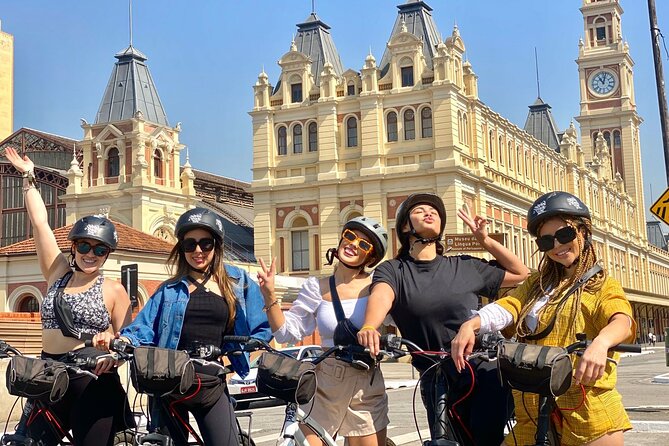
Next is Vila Itororó, an historical architectural complex in the Bela Vista neighborhood. It was built between the 1920s and 1930s, and it includes houses, gardens, and sculptures. That matters, because São Paulo at night can blur into an endless stream of buildings. Vila Itororó interrupts that rhythm with a more human-scale, designed environment.
A portion of the complex is undergoing restoration, and it hosts cultural events, exhibitions, and community activities. So even if parts look under renovation, the neighborhood still functions as a place people use for culture and community. That’s the kind of detail I enjoy on tours: you see the city as something in motion, not as a frozen postcard.
The stop is about 15 minutes, with admission listed as free.
Centro Cultural São Paulo: Art, Theater, Music, and Cinema in One Slot
Then comes Centro Cultural São Paulo, in the Vergueiro region. This is a culture hub where you can catch contemporary art exhibitions, theater performances, musical concerts, cinema screenings, and even use a library with a vast collection.
On a bike tour, you’re not meant to spend hours inside. Instead, this stop gives you context. It tells you that São Paulo’s arts scene isn’t confined to one museum address. It lives inside multi-purpose spaces that also host films and live performance.
If you like cities where you can pivot from architecture to ideas quickly, this is a smart pause. The stop is about 15 minutes and listed as free entry for visitors.
The Orthodox Cathedral: Golden Domes, Byzantine Feel, and Cultural Use
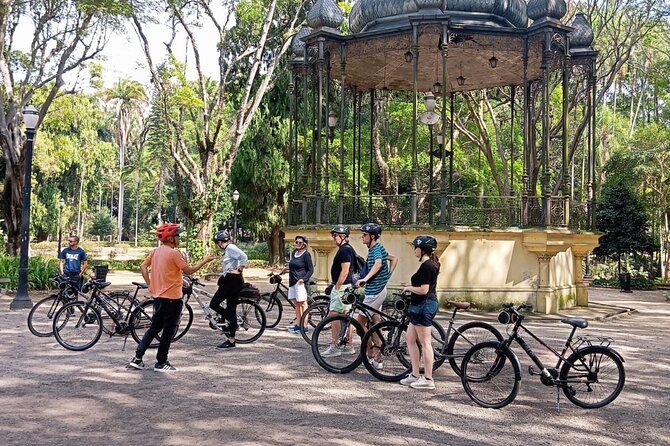
Another religious landmark appears at the São Paulo Orthodox Metropolitan Cathedral, the main church of the Orthodox community in the city. The architecture takes inspiration from Russian and Byzantine churches, including golden domes and elaborate decoration.
Even though it’s a place of worship, the tour notes that it also hosts cultural and religious events. That means the building isn’t just a backdrop. It’s used. Seeing it as both a spiritual site and a cultural venue adds dimension to the neighborhood you’re moving through.
Time here is roughly 15 minutes, with admission listed as free.
Avenida Paulista: The Big Boulevard Where Politics and Culture Collide
At this point you’re riding along Avenida Paulista, one of São Paulo’s main thoroughfares and its cultural, commercial, and financial center. It’s also where you’ll find museums, theaters, and cultural centers stacked near shops and restaurants.
What I like about Avenida Paulista is that it’s not just a place to shop. It’s described as the site of important cultural and political events and demonstrations. In a short night ride, the guide’s job is to show you why the avenue matters beyond being busy. You’ll get a sense of how the city expresses itself publicly.
You spend around 15 minutes around Paulista-related stops, with most scheduled admission listed as free.
Casa das Rosas: Coffee-Lord Mansions to Poetry and Literature
Casa das Rosas is dedicated to cultural events, focusing on poetry and literature. During the tour stop you can expect it to be explained as a place for soirées, recitals, book launches, plays, preparatory courses, and exhibitions.
The building itself has a strong setting. The mansion was built in 1935 when the Paulista region was filled with mansions of coffee lords. It was designed by architect Ramos de Azevedo and lived in until 1986, when it was expropriated by the state government. Later, in 1991, it opened as a cultural space.
Even if you only see it briefly, the point is clear: this is not a generic cultural center. It’s a mansion with a specific story tied to São Paulo’s economic past and its shift into arts and literature.
Time on this stop is about 15 minutes, and admission is listed as free.
Parque Trianon: A Green Break That Feels Like Atlantic Forest Left Behind
In the middle of the avenue, Parque Trianon works like a reset button. It’s described as a green breath of Atlantic Forest remaining amid the buildings. The park covers almost 50,000 square meters and is known for tropical vegetation, exotic species, wild animals, and more than 30 species of birds.
On a bike, you don’t have time to wander like you would in daytime. But you can still feel the difference in air and space. If you’re the type who likes a short nature break in a city setting, this stop is a good one.
The tour also links the name to the old Trianon Club, which existed until the mid-1950s, and notes that MASP is located on the other side of Avenida Paulista. So when you see the park and then later see MASP, the story connects in your head.
MASP: Lina Bo Bardi’s Red Pillars and Art Under a Long Span
The São Paulo Museum of Art, MASP, is one of the city’s main cultural institutions and one of its most recognizable visual landmarks. It was created by journalist Assis Chateaubriand and has a collection of more than 10,000 pieces, including works by artists like Monet, Picasso, and Di Cavalcanti.
The architecture is a big reason MASP is worth seeing, even if you’re not going inside. The museum was designed by Lina Bo Bardi and is known for four large red support pillars and a 74 meter free span. That design choice makes the building feel airy and distinctive, and it creates a strong silhouette at night.
If you like photo stops, this is a good moment to slow down for pictures. Even with a short scheduled time, MASP usually gives you enough time to capture that red structure against the city backdrop.
Conjunto Nacional: First Shopping Center in Latin America, Still Useful
Conjunto Nacional is described as the first shopping center in Latin America, opened in 1958 on Avenida Paulista. It’s both commercial and cultural, with shops, restaurants, bookstores, and apartments.
The building is divided into a horizontal structure for commerce and a residential complex, including the Horsa building. It’s also tied to institutions like Livraria Cultura, a gym, an exchange office, drugstores, and Cine Livraria Cultura.
If you pay attention to the way the tour connects architecture to daily life, Conjunto Nacional fits perfectly. This is a landmark you don’t just look at. It’s a place where people still go for shopping and entertainment.
Rua Augusta and Praça do Ciclista: Night Energy and Cycling Culture
As the route continues, you reach Rua Augusta, a street known for nightlife, theaters, bars, and alternative shops. This is a good area to understand the social side of São Paulo. You see a nightlife corridor, and you get the sense that the city’s energy is visible even when you’re moving on a bike.
Then you stop at Praça do Ciclista, on Avenida Paulista. The park is a meeting point for cyclists and bicycle enthusiasts, and it’s also described as a starting point for cycling tours around the city. Events related to urban mobility take place here.
I like this stop because it shifts the focus from tourism to city life. It reminds you that bikes are part of the urban story here, not just a sightseeing activity.
Praça Vilaboim and Pacaembu: Arches, Public Space, and Football Pride
Next is Praça Vilaboim, also known as Praça dos Arcos. It’s in Higienópolis and known for decorative arches. The tour frames it as a public space used for cultural events, craft fairs, and artistic performances.
Then you reach Pacaembú Stadium, one of São Paulo’s traditional football stadiums. The stadium hosts matches and also cultural and sports events. In the Pacaembú neighborhood, there’s also a Football Museum dedicated to the history of the sport in Brazil.
Even if you’re not a hardcore soccer fan, the value here is how São Paulo organizes identity around shared spaces. Stadiums are not just for games. They anchor communities and create a sense of who belongs and who gathers.
Minhocão on Weekends: An Elevated Road Turned Into a Leisure Space
One of the most interesting elements of this route is Minhocão, the President João Goulart Elevated Highway. During the week, it’s an important traffic artery cutting through downtown São Paulo. But on weekends, it is closed to cars and becomes a leisure space for pedestrians, cyclists, and cultural events.
This matters because it’s a view of urban planning that feels flexible. The tour includes Minhocão as a stop, so you get a chance to see how São Paulo can re-purpose infrastructure into public life when the rules change.
If your tour date lands on a weekend, you’re more likely to feel that transformation. If it’s not a weekend, you’ll still recognize the structure’s scale and impact on the city layout.
Safety, Pace, and the One Thing to Plan Around: Hills
São Paulo is busy and congested, and a night bike tour only works if the guide keeps you on safer routes and out of the worst traffic. The tour is designed around a guide leading the way, and one rider credited their guide with choosing safe bike trails in the street.
That said, hills are real here. One review described a mix-up in bike supply, with a plan for electric bikes but only one electric bike being available. Later, on a steep hill, the group ended up taking Ubers to make the ride manageable when everyone was tired.
I can’t promise how the bike situation will be handled for your group, but I can tell you what to do: if hills worry you, plan on using whatever assist options your operator provides, and consider asking ahead for the most supportive bike available. If you’re fit and comfortable, you’ll likely love the ride. If you’re not, you can still enjoy the tour, but you should prepare for extra effort or be flexible.
The End-of-Ride Toast: Caipirinha and a Clean Finish
After the final stops, the tour ends back at the meeting point. The included caipirinha at the end is a simple, smart close. It’s a treat you can enjoy after you’ve done the hard part, riding through the city.
It also helps you land your mental notes. By the time you finish, you’ve seen everything from big neo-Gothic architecture to cultural centers, Japanese neighborhood streets, art museum architecture, and the unique view of Minhocão. That’s a lot for a 2 to 4 hour ride, and the caipirinha gives you an excuse to slow down and feel like the tour actually ended, not just paused.
Who This Tour Fits Best, and Who Might Want Something Else
This is a great fit if you want your first or early night in São Paulo to feel organized. You’ll cover major landmarks and several neighborhoods without spending the whole evening commuting between separate attractions.
You’ll also like it if you prefer walking at a distance. A bike tour can show you more than a stroll, but you still get stops where you can look closely.
Consider a different style of tour if you strongly dislike physical effort or steep climbs. Even with a guide and a small group, the route includes enough elevation to matter, and you may feel it by the end. If you know you need extra help to ride comfortably, ask questions in advance so you can match your comfort level to the bike setup.
Should You Book the São Paulo Uptown Bike Tour?
Book it if your goal is a high-efficiency night introduction to São Paulo, with a small group, a guide who picks safer ways to ride, and a route that connects Paulista Avenue to downtown. The inclusion of a caipirinha toast and the variety of stops, from Catedral da Sé to MASP and Minhocão, makes it feel like more than just a “ride around the city.”
Pass or switch options if hills are a deal-breaker for you, or if you need a slower, deeper museum-style pace. This tour is about movement and quick cultural hits.
If you do book, show up early for the coffee stop if you can, dress for wind and temperature swings, and pay attention to bike choice so you’re set up for the ride you actually want.
FAQ
How long is the São Paulo Uptown Bike Tour?
The tour lasts about 2 to 4 hours.
What does the São Paulo Uptown Bike Tour cost?
It costs $95.00 per person.
Where does the tour start?
The tour starts at Portinha 183R, França Pinto, 183, Vila Mariana, São Paulo, SP 04016-001, Brazil.
Where does the tour end?
The tour ends back at the meeting point.
What is the maximum group size?
This activity has a maximum of 10 travelers.
What is included at the end of the ride?
You get a caipirinha provided at the end of the ride.
Are there admission tickets you need to pay for the stops?
The listed admission for the scheduled stops is free.
Does the tour operate in bad weather?
Yes. It operates in all weather conditions, so dress appropriately.
Can I cancel for a full refund?
Yes. You can cancel up to 24 hours in advance for a full refund. If you cancel less than 24 hours before the start time, the amount you paid is not refunded.
Newest São Paulo reviews
- Body Massage – by Venus’ Secret Spa – Sao Paulo★ 5.0 · 15 reviews
- Private Tour: Santos & Guarujá Beaches (8H) – São Paulo Pickup★ 4.5 · 15 reviews
- Private Arrival Transfer: Guarulhos International Airport★ 4.5 · 15 reviews
- Taxi from Guarulhos airport to São Paulo capital★ 5.0 · 15 reviews
- Historical and Cultural Tour of the Center DE São Paulo★ 5.0 · 16 reviews
- São Paulo Coffee Tour: Farm, Culture & Lunch Included – 6h★ 4.5 · 16 reviews
- Private Half-Day Tour of São Paulo Highlights★ 5.0 · 17 reviews
- Private Transfer São Paulo Airport to Hotels with Quick City Tour★ 5.0 · 17 reviews
São Paulo Highlights, compared.

São Paulo’s Full Day City Tour: Main City Sights in 7 Hours – (Shared Group)
Read our review →
5-hour Private Tour Of São Paulo With Its Main Sights – Optional Airport Pickup
Read our review →
Main City Sights in 7 Hours – Shared Group Tour
Read our review →
6-Hour Classic Half-Day Private Tour of São Paulo – Optional Airport Pickup
Read our review →
Amazing São Paulo overview in 4 or 5 hours with a private guide
Read our review →
Browse the lists this tour appears in