
Reviewed · SãO PAULO HIGHLIGHTS
Secrets of Downtown São Paulo Bike Tour
What makes this tour interesting is how quickly you can get oriented in São Paulo’s huge downtown zone by bike. I like that it starts with something practical and local, then keeps moving so you spend less time guessing routes and more time seeing real places. A first-timer will still feel carried by the pace and the stops at each landmark, not dumped into traffic.
I especially like the Portinha 183 coffee-and-snack start. It gives you fuel, Brazilian comfort food like pão de queijo and tapiocas, and a coffee-culture context before you roll out.
My only drawback to flag is effort. On a hot, humid day the ride can feel demanding, and you’ll want to be a competent cyclist and comfortable with busy intersections. One rider even wished for a bell to help with pedestrian awareness, so keep that in mind when you’re thinking about your comfort level.
Key highlights you should care about
- Coffee and snacks before you ride so you are energized from the first 30 minutes
- Paulista Avenue plus Japan House on a route built for photos and short breaks
- A big downtown sweep that moves from Praça da Sé and the Cathedral to major cultural centers
- A mix of architecture, museums, and neighborhood stories including Liberdade’s Japanese culture and Black history
- Parque Minhocão style city energy via the elevated park atmosphere
- Food moments you can choose at Mercado Municipal, with guidance but not forced spending
Getting Oriented Fast on a Downtown São Paulo Bike Loop
São Paulo is one of those cities where walking can feel like a full-time job. Distances are big, traffic is intense, and you can lose time just relocating. This bike tour solves the problem by turning downtown into a manageable loop, with an intentional rhythm: snack first, then landmarks, then a smooth set of cultural stops.
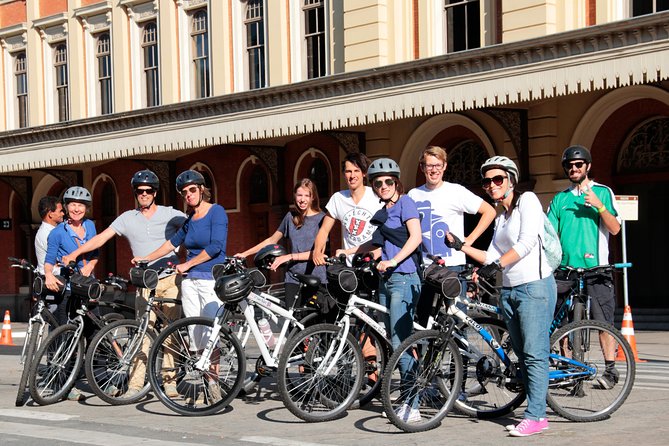
One thing I like is the mix of “see it in real life” with “understand what you’re seeing.” The tour doesn’t just point at buildings. It connects them to how the city grew, from coffee barons and early Jesuit roots to modern cultural hubs. And the group stays small, with a maximum of 15 people, which makes it easier to ask questions without shouting over the street.
The vibe is also clearly built around safety and staying together. Recent accounts point to bike lanes a lot of the way and guides who actively manage crossings. You can still expect busy streets, so you should show up with focus, not a casual “hands-off” attitude.
More Cycling Tours in São Paulo
- São Paulo: Downtown Historical Bike Tour
★ 4.9 · 191 reviews - Street Art and Park Bike Tour
★ 5.0 · 56 reviews - São Paulo Uptown Bike Tour
★ 5.0 · 37 reviews
Portinha 183: Coffee Culture and Brazilian Comfort Food First
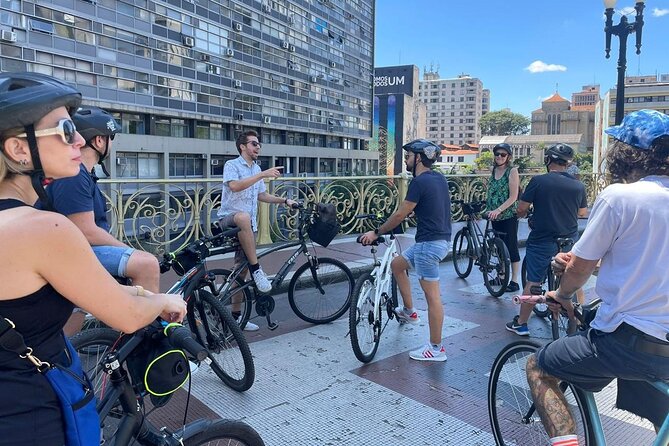
Your first stop is Portinha 183 in Vila Mariana, and it’s a smart move. You start with a café atmosphere in a neighborhood that feels more local than tourist-grid. You get a chance to slow down, meet your guide and group, and get your bearings before the ride gets serious.
The coffee here is the headline, with options to try different types of coffee. But what makes the start feel very Brazilian is the menu beyond caffeine: pão de queijo, tapiocas, brigadeiros, and sandwiches made with local ingredients. Even if you keep it light, this is the kind of pre-ride meal that won’t leave you flat.
Practical note: this stop is listed as 30 minutes, and admission ticket is not included. Translation: plan for what you choose to eat and drink, not just the base tour cost. It’s still good value because you’re getting a calm kickoff and a food moment that feels like São Paulo, not a generic “tour snack.”
Paulista Avenue, MASP, and Japan House: Culture on a Street That Moves
Avenida Paulista is São Paulo’s main stage, and biking helps you absorb it in a way transit can’t. You’ll roll past major banks, museums like MASP, theaters, restaurants, and parks, all while the avenue does what it does best, lots of people and lots of energy.
If your day lines up with Sunday, there’s a special bonus. The avenue closes to cars, which means you can experience Paulista in a more bike-friendly, street-artist and market-like environment. Even on non-Sunday days, the avenue is still the best place to see how modern São Paulo works, fast.
This is also where the free cultural stops hit. MASP is a star: bold modernist architecture and a collection of over 10,000 works, stretching from European and Brazilian art from Renaissance eras to contemporary pieces. You may not have time for a full museum deep session, but seeing the building and understanding its role in Paulista culture is part of the payoff.
Then there’s Japan House São Paulo, designed by Kengo Kuma and opened in 2017. The building uses hinoki wood and washi paper in the façade, which gives it a different sensory feel than typical concrete museums. The entry is free, and the center offers exhibitions, events, a library, a shop, and the Aizomê restaurant. Even a short stop makes sense here because you’re not just learning facts, you’re seeing how Japanese design language translates in a Brazilian city.
This segment is a big “photo and reset” window too. The tour is built so you get time to rest and take pictures, not just rush through snapshots.
Casa das Rosas to Praça da República: Coffee-Baron Homes and Downtown Craft Energy
After Paulista, you head toward Casa das Rosas, often called the House of Roses. It’s a cultural center in a former residence, and it matters because it preserves the kind of architecture tied to the coffee barons who shaped São Paulo’s wealth and influence. This stop is listed as 10 minutes, and admission ticket is included, which helps keep your costs predictable.
From there you move toward Praça da República, a historic square in downtown surrounded by early 20th-century architecture and taller modern buildings. On weekends, it hosts an arts and crafts fair with local food and handmade goods. So even if you’re not shopping, you can feel the city’s creative mix at street level.
What makes this portion valuable is the contrast. You’re moving through areas that look like separate eras of São Paulo, yet you experience them in one continuous ride. That’s the real advantage of biking here, you get change without losing the thread.
More of São Paulo:
- Skydive Tandem – São Paulo – Brazil
★ 5.0 · 1,840 reviews - São Paulo’s Full Day City Tour: Main City Sights in 7 Hours – (Shared Group)
★ 5.0 · 1,691 reviews - 5-hour Private Tour Of São Paulo With Its Main Sights – Optional Airport Pickup
★ 5.0 · 643 reviews - São Paulo: Main City Sights in 7 Hours – Shared Group Tour
★ 4.9 · 587 reviews
Farol Santander and the Old City Web: Panoramas and Practical Context
Farol Santander is housed in one of São Paulo’s tallest historic skyscrapers in the downtown core. It offers panoramic city views, plus art exhibitions, workshops, and interactive installations. The building was completed in 1947 and used to be a headquarters for Banco Santander Brazil before becoming a cultural hub.
This stop is short, listed as 10 minutes, but it’s the kind of place that helps you make sense of scale. From up high, downtown stops being a pile of streets. You start to see how neighborhoods connect, and why people talk about São Paulo as a city that keeps expanding outward.
Then the route continues through the city’s oldest parts, with stops that reflect what grew from a small village founded by Jesuit priests with indigenous help into one of the world’s biggest cities. You’ll also pass areas with old overpasses and modern murals, so the tour naturally shows you how São Paulo mixes layers instead of wiping them clean.
Pateo do Collegio and Theatro Municipal: Where the City Begins and Shows Itself
Pateo do Collegio is the historic birthplace of São Paulo, founded in 1554 by Jesuit priests. It includes a church, a museum, and archaeological remains. This is one of those stops that changes how you read the modern city, because it forces you to think about time depth. You are looking at origins while still in a downtown that feels like the present.
The admission ticket is listed as free. You’ll get a short 10-minute visit, so it’s not an all-day museum crawl. But even a quick visit can do something important: it gives a baseline for the stories you hear on later stops, like how wealth, faith, and migration shaped the city.
Next up is Theatro Municipal de Sao Paulo, opened in 1911 and described as one of Brazil’s most important cultural landmarks. It features architecture inspired by European opera houses, and it hosts concerts, ballets, and operas. This stop is listed as 5 minutes and free.
Even if you’re not planning to attend a performance, seeing the theater from the outside (and learning what it symbolizes) helps you understand São Paulo as a cultural city, not only a financial one. And in practical terms, the theater area also gives you a break in the ride rhythm, a moment to stand still without falling behind.
Centro Cultural Banco do Brasil to Catedral da Sé: Free Culture and the Big Neo-Gothic Moment
Centro Cultural Banco do Brasil (CCBB) is another core downtown institution, in a restored historic building. It hosts free or affordable exhibitions, films, theater, and lectures. The tour lists this as 10 minutes with admission ticket free, which makes it one of the best “culture per minute” stops on the route.
Then you reach Catedral da Sé, also listed free. This neo-Gothic church was completed in 1954 and is one of the largest churches in Brazil. You’ll see stained glass windows and a beautiful crypt, and it sits right in Praça da Sé, the main square of the historic center. This is a stop that tends to work even for people who aren’t into churches. The scale and visual impact do the talking.
If you’re trying to understand São Paulo quickly, this pairing makes sense. CCBB shows modern cultural programming in a restored downtown shell. The Cathedral shows faith and history in a structure built to dominate the skyline. You finish this segment with both the arts and the religious roots firmly in view.
Parque Minhocão and Pinacoteca: Creative City Life Above the Streets
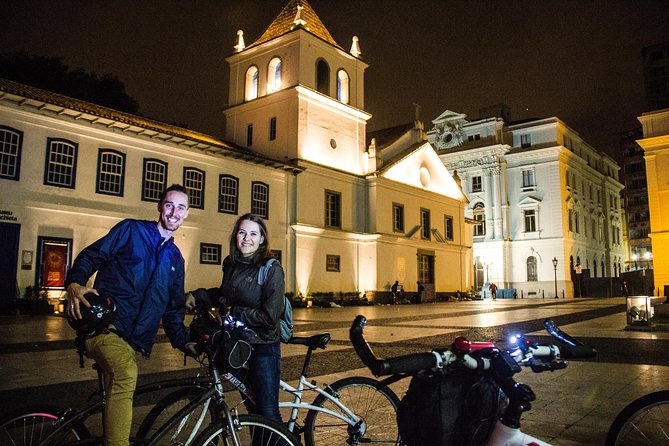
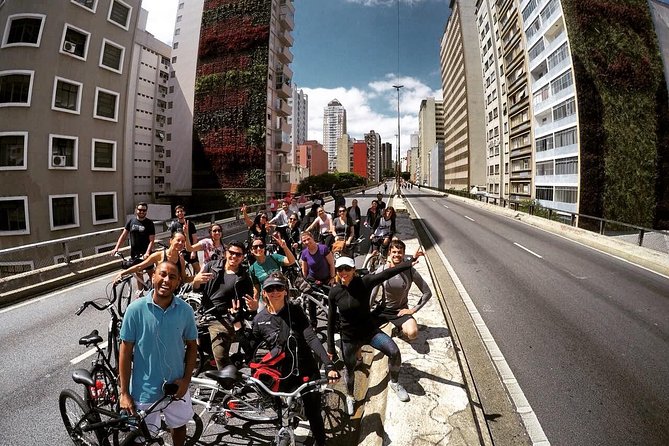
Parque Minhocão is the kind of place where you feel like you’re seeing São Paulo’s personality, not just its postcard highlights. It’s an elevated park built on a former highway, and it’s closed to cars on evenings and weekends. Locals use it to walk, bike, skate, and relax above the streets.
On certain days, the elevated park vibe becomes part of the tour’s real energy. One rider described how on a Saturday departure the overpass was closed to cars and allowed bikes, and that change made the experience special. Since the park is known to be car-free during set times, you might catch that atmosphere depending on when you go.
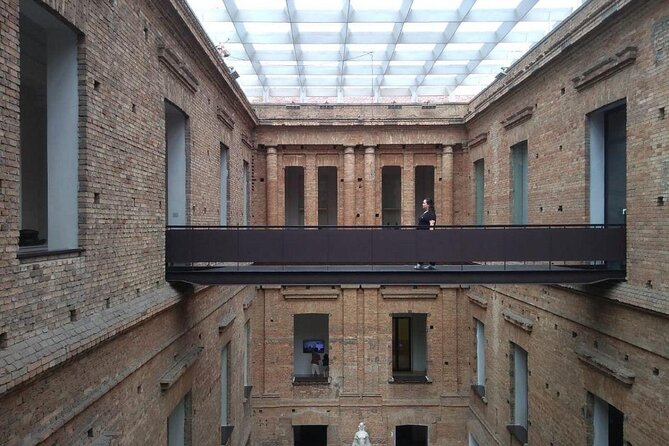
Pinacoteca de São Paulo is nearby in the tour flow and is one of Brazil’s oldest and most important art museums. It’s housed in a restored 19th-century building and features Brazilian art from classical to contemporary, plus temporary exhibitions. Your stop here is listed, but the main takeaway is the museum’s role in Brazilian art, not a complete gallery marathon.
I like this area because it adds texture. You’re not only seeing buildings and squares. You’re seeing daily life, movement, and the idea that public space can be repurposed.
Museu das Favelas and Liberdade: Two Stops That Change How You Think
Two of the most meaningful parts of the route are Museu das Favelas and Liberdade, because they push you beyond a typical downtown loop.
Museu das Favelas focuses on the history, culture, and identity of Brazil’s favelas. It includes exhibitions, educational programs, and a specialized library. The museum highlights creativity and resilience in marginalized communities, giving you a chance to understand Brazil’s urban realities in a structured way. It’s a stop worth treating with respect and time, even if your visit is short.
Then you transition to Liberdade, famously São Paulo’s Japanese district and home to a large Japanese community outside Japan. You’ll likely notice the red lanterns and Asian markets style that makes the neighborhood visually distinct.
But here’s the part that many people miss, and it’s explicitly part of this tour’s story. The name Liberdade means freedom. In the 18th and 19th centuries, the area included a pelourinho, a whipping post, where enslaved Africans were punished and sold. It also served as a gathering place for the Black community and a key area for abolitionist movements.
That context changes what you see. It stops the neighborhood story from being only about food and festivals. It becomes about how people survived, resisted, and built community in the same streets that now attract visitors.
Mercado Municipal, Parque da Luz, and Estação da Luz: Food and Train-Station Grandeur
The Mercado Municipal de São Paulo is a loud, colorful food hub known for fresh produce, meats, and traditional Brazilian snacks. It’s also famous for the mortadella sandwich. Your stop is listed as 20 minutes, and admission ticket is not included, so budget for whatever you order.
Even if you skip a full meal, the market is a quick way to understand daily eating habits in São Paulo. It’s food as culture, and it’s also a good place to reset before the last stretch.
Then you head to Parque da Luz, listed as the oldest public park in São Paulo. It has gardens, sculptures, and walking paths, and it’s adjacent to MASP and the Luz Train Station. It’s a calm break inside an otherwise intense day.
Estação da Luz brings the architecture wow factor. The station is known for Victorian design inspired by London’s St Pancras. It opened in 1901 and was part of the gateway for coffee exports that shaped the economy. Today it houses the Museum of the Portuguese Language and acts as a major transit hub. Your stop is listed as part of the route, so you’ll likely get a look at the building and a quick story about what it meant in coffee-era trade.
Together, these stops work well because they cover two kinds of heritage, how people ate and how people moved goods.
Praca Franklin Roosevelt and Galeria do Rock: São Paulo’s Creative Side in One Last Ride
Práça Franklin Roosevelt is a lively downtown square known for modernist architecture and an everyday creative crowd. It’s popular with skaters, artists, and locals. The surrounding area includes bars, theaters, and independent spaces, so it feels like São Paulo’s present-day culture, not only its past.
Then there’s Galeria do Rock, a shopping center famous for alternative culture. It’s known for record stores, tattoo studios, streetwear shops, and skate gear. It’s been a landmark for rock, hip-hop, and punk fans since the 1960s, shaping a youth culture and underground music scene.
This last segment matters because it keeps the tour from becoming only museums and monuments. You end the ride with an area that explains how the city expresses itself today.
Price, Time, and Why $85 Can Actually Make Sense
At $85 per person for about 3 hours and 5 minutes, this is not a “budget” tour in the way a free walking tour can be. But biking adds real value in São Paulo, where you can only see so much on foot before the day slips away.
Here’s what helps the price feel fair. You get a guided route designed to hit many major sights in one run, with multiple cultural stops where admission is free. Casa das Rosas is listed as included, Japan House is free, and several other key stops are free as well. You also spend part of the morning with a food stop where you can try Brazilian staples before you ride.
The main caution is whether you care about the mix of stops. This tour leans cultural and architectural, plus a bit of food. If you want only one neighborhood or only one museum, a targeted day trip might suit you better. And if you’re the kind of traveler who hates physical effort, remember the ride can be demanding on humid days.
Should You Book This Downtown São Paulo Bike Tour?
Book it if you want a fast, guided way to connect São Paulo’s biggest downtown landmarks, especially Avenida Paulista and the historic center. It’s a strong choice when you want both photos and context, and when you appreciate short stops that keep the day moving.
Skip it or rethink it if you are not confident on a bike, or if you’re planning to ride on a day you expect extreme heat and humidity. This isn’t described as a gentle cruise, it’s a ride with active time on the streets.
If you do book, set yourself up for success: wear comfortable clothes for a few hours of biking, be ready for busy intersections, and treat the cultural stops like you actually care about them. The best part of this tour is that it can make a huge city feel organized without sanding off the real character.
FAQ
How long is the Secrets of Downtown São Paulo Bike Tour?
It runs about 3 hours and 5 minutes.
How much does the tour cost?
The price is $85.00 per person.
What is the minimum age for the tour?
The minimum age is 13 years.
How many people are in a group?
The tour has a maximum of 15 travelers.
Are any museum or cultural entries included in the tour price?
Yes. Casa das Rosas has admission ticket included. Several other stops are listed as free, including Japan House São Paulo, and multiple cultural sites around the route. Mercado Municipal and Portinha 183 are listed as not included.
What happens if the weather is bad?
This experience requires good weather. If it gets canceled due to poor weather, you are offered a different date or a full refund.
Newest São Paulo reviews
- Body Massage – by Venus’ Secret Spa – Sao Paulo★ 5.0 · 15 reviews
- Private Tour: Santos & Guarujá Beaches (8H) – São Paulo Pickup★ 4.5 · 15 reviews
- Private Arrival Transfer: Guarulhos International Airport★ 4.5 · 15 reviews
- Taxi from Guarulhos airport to São Paulo capital★ 5.0 · 15 reviews
- Historical and Cultural Tour of the Center DE São Paulo★ 5.0 · 16 reviews
- São Paulo Coffee Tour: Farm, Culture & Lunch Included – 6h★ 4.5 · 16 reviews
- Private Half-Day Tour of São Paulo Highlights★ 5.0 · 17 reviews
- Private Transfer São Paulo Airport to Hotels with Quick City Tour★ 5.0 · 17 reviews
São Paulo Highlights, compared.

São Paulo’s Full Day City Tour: Main City Sights in 7 Hours – (Shared Group)
Read our review →
5-hour Private Tour Of São Paulo With Its Main Sights – Optional Airport Pickup
Read our review →
Main City Sights in 7 Hours – Shared Group Tour
Read our review →
6-Hour Classic Half-Day Private Tour of São Paulo – Optional Airport Pickup
Read our review →
Amazing São Paulo overview in 4 or 5 hours with a private guide
Read our review →
Browse the lists this tour appears in