
Reviewed · HALF-DAY
Half-Day Architecture Walking Tour in Rio
Rio de Janeiro has a lot of postcard sights, but this half-day walk takes you into the city’s architectural thinking. You’ll move through Downtown Rio and come away with a clearer sense of how power, religion, and modern design shaped the blocks you see today.
Two things I really like about this tour: the pacing and the explanations. You get an easy, mostly on-foot route (about 4 hours) with a guide who can connect the buildings to the eras that produced them, and one review highlights Alberto as a tri-lingual historian who brings Rio’s older layers into focus. The only thing to plan around is that a chunk of the most interesting parts involve church and museum stops, and the entrance fees there are not included.
Key Architecture-Walk Takeaways (What You’ll Actually Notice)

- Two start times let you pick what works best for your day in Rio.
- You begin at Largo da Carioca, treated as the starting point for Rio’s city occupation.
- The route mixes religious architecture with 20th-century modernism in a way most visitors miss.
- You spend dedicated time in Cinelandia and can actually spot the Art Deco mood there.
- The tour highlights Le Corbusier’s Five Points of a New Architecture as part of Palacio Capanema’s design.
- Your last stop points you straight at brutalism at the Museu de Arte Moderna do Rio de Janeiro.
Downtown Rio on Foot: Why This Architecture Route Works So Well
If you like cities that feel like they’re arguing with themselves, Rio is perfect. The best way to understand that is to walk through the transitions, not just photograph the big winners. This tour leans into that idea, connecting religious beginnings, early European-influenced design, and mid-century modernism, all within a compact Downtown loop.
You’ll also get something that’s hard to do on your own: a guide who helps you look at buildings with purpose. Instead of wandering, you’re pointed to the details that signal when and why a style changed, like the shift from older religious structures to 1930s modernist thinking and then to the rougher, bolder forms of brutalism.
The group size cap is also a quiet win. With a limit of up to 15 travelers per guide, you’re less likely to get lost in a loud crowd, and you can ask questions without shouting over everyone.
More Walking Tours in Rio de Janeiro
- Rio de Janeiro: Rocinha Favela Walking Tour with Local Guide
★ 4.8 · 3,052 reviews - Rio De Janeiro: Half-Day Rocinha Favela Walking Tour
★ 4.7 · 2,272 reviews - 3 Hour Rocinha Favela Walking Tour with a Local Guide
★ 5.0 · 833 reviews
Meeting at Carioca (CentroCentro) and What to Bring
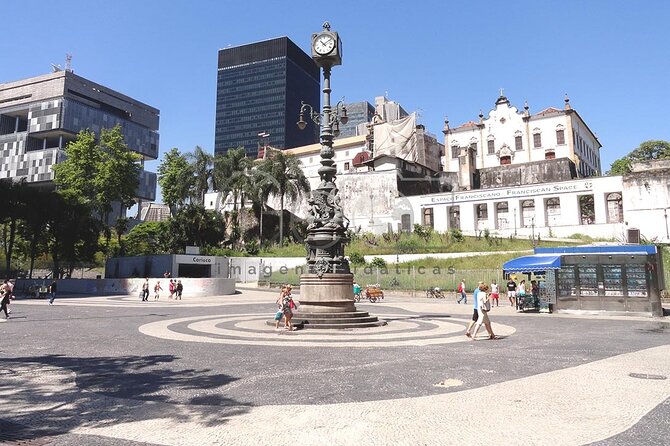
The meeting point is Carioca / CentroCentro, Rio de Janeiro. It’s set up near public transportation, so you should be able to reach it without hiring a private transfer just to start a walking tour.
Bring comfortable clothing and walking shoes. You’re on your feet long enough that footwear matters, and the tour is only about four hours, so you don’t want sore feet cutting your attention in half.
If you want pickup based on your hotel location, the operator asks you to contact them to confirm the time. Also note the tour may request a copy of your ID, so keep that ready.
Largo da Carioca: Rio’s Starting Point and the First Big Visual Clue
Your first stop is Largo da Carioca, described as the heart of Downtown Rio. You’re told this is where the occupation of the city began, which instantly changes how you interpret the area. You’re not just looking at streets, you’re looking at a place that anchors the city’s origin story.
You’ll spend about an hour here, with a chance to orient yourself and spot key religious architecture in the area. The tour also frames what you’ll see next, so when the walk continues toward the Church and Convent of Saint Anthony, you’ll understand why this spot matters.
One practical tip: use this first hour to slow down and look up. Largo da Carioca is your warm-up, and it’s easier to get your bearings here than later when the group is moving.
Convento de Santo Antônio: Early Catholic Power and the Mass Option
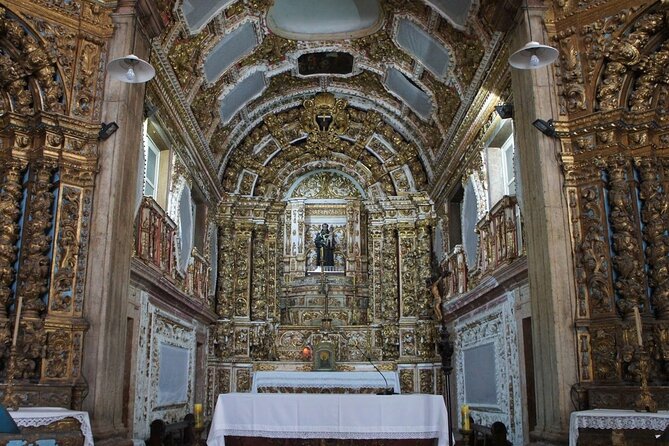
Next you head to the Convent of St. Anthony, a major early Catholic construction in Rio. The building is dated to 1608 and is tied to the Order of Saint Frances, so this is where the tour leans heavily into colonial-era influence.
Time on site is about 30 minutes, and you’ll want to plan for the entrance cost. The ticket for the convent is 10 BRL per person, not included in the tour price.
Here’s the part that can make your visit feel special: if you’re lucky, you may be able to attend a mass. Even if you do not, the setting is still worth it because the tour is treating this as a landmark of early Catholic architecture, not as a quick photo stop.
Another way to spend a day in Rio de Janeiro:
- Rio de Janeiro: 6-Stop Highlights of Rio with Lunch
★ 4.4 · 5,157 reviews - Christ the Redeemer Entry Ticket by Corcovado Train
★ 4.4 · 4,476 reviews - Rio’s City Tour – Tickets for Christ, Sugar Loaf & Lunch included
★ 5.0 · 4,389 reviews - Full Day: Christ Redeemer, Sugarloaf, City Tour & Barbecue Lunch
★ 4.5 · 3,142 reviews
Cinelândia: Art Deco Buildings and a Fast Way to Spot the Style
Cinelândia is the next stop, and you’ll spend about 30 minutes there. The focus is on Art Deco buildings, and this is a good moment to reset your eye.
Art Deco is easier to recognize when you know what to look for. On this stop, you’ll be guided to the overall look of the facades and the polished “20th-century optimism” feel that Art Deco often carries. The value here is that you’re not just looking at one building, you’re seeing a cluster, which makes the style pattern click faster.
The good news for time management: this stop is relatively short. You get style recognition without turning the day into a slow crawl.
Palacio Capanema: Le Corbusier’s Five Points in Rio’s Modernist Story
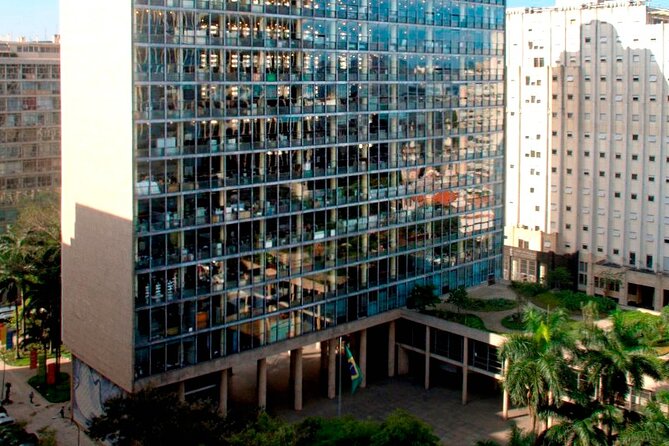
Now you shift into one of the tour’s biggest architecture “payoffs”: Palacio Capanema. This building is linked to Le Corbusier’s Five Points of a New Architecture, and the design period is given as 1935 to 1936.
What I find especially useful here is that you get context, not just name-dropping. The building is described as the work of a team of young architects, including Lucio Costa and Affonso Eduardo Reidy. You’re also told that Oscar Niemeyer, who later became Brazil’s best-known architect, was an intern in Costa’s office at the time.
So for you, the takeaway isn’t only that the building is important. It’s that modernism in Rio wasn’t invented in a vacuum. It was built through training, collaboration, and the influence of modern design principles being translated into local realities.
The stop lasts about 30 minutes, and because admission isn’t listed here, you can focus on observation and explanation without extra ticket steps.
Inside Edifício Austregésilo de Athayde: Modernism as a Symbol You Can See
There’s another modernist-focused stop connected to Edifício Austregésilo de Athayde. You’ll visit a location inside it, and the tour frames the building as a symbol of modernist architecture in Rio.
The time here isn’t clearly listed the way other stops are, but it matters for the overall flow. It’s the tour’s bridge, helping you connect the earlier modernist moment at Palacio Capanema to the bolder, more emotionally forceful forms you’ll hit at the museum.
This is also a good place to ask your guide what to watch for. Modernism can look “clean” from far away. Up close, it often comes down to structure, rhythm, and how the building manages light and space.
Museu de Arte Moderna (MAM): Brutalism, Concrete Attitude, and What to Look For

The tour ends with time at the Museu de Arte Moderna do Rio de Janeiro, where you’re told the museum inaugurates the brutalism aesthetic in the city. This is your last stop, about 30 minutes, and it’s the strongest shift from “curved and composed” modernism into something more raw and blunt.
The entrance fee here is 20 BRL per person, also not included. So if you’re budgeting tightly, make sure you plan for both paid entries: the convent and the museum.
Brutalism, in plain terms, often means forms that feel sturdy and unapologetic. On this stop, you’re likely to notice how the museum presents itself, the heavy, structural look that can feel almost like the building is showing its bones. Even if brutalism isn’t your taste, it’s a useful contrast, and you’ll walk away with a better sense of what Rio decided to express in later 20th-century design.
How the Guide Changes the Whole Experience (Especially Alberto)
A walking tour lives or dies by the guide. This one has a standout factor: one of the reviews specifically calls out Alberto, describing him as fluently tri-lingual and deeply invested in Rio’s story across centuries.
The best part is how the tour can turn observation into understanding. In one described moment, Alberto had the group use a hands-on trick inside a church, having people lie in the nave to experience a trompe l’oeil vaulted ceiling painting. Even if you’ve never heard the term before, the method makes sense: when architecture includes illusion, you often have to change your position to see the effect the way the designer intended.
If you’re the kind of person who likes architecture but sometimes finds it hard to connect the dots, this guide style matters. You’ll spend the day not just looking, but learning what to look for.
Price and Value: Where the $60 Ticket Gets You
The tour price is $60 per person, and it includes the tour guide. That’s the core value: you’re paying for interpretation, not just for access.
You do need to budget separately for entrances. The convent is 10 BRL per person, and the museum is 20 BRL per person. So your total out-of-pocket for entry tickets can add up quickly, depending on exchange rates and how much you plan to do beyond the tour.
Still, the value holds because the route is structured. You’re not paying for random wandering. You’re paying for targeted stops that explain why each building matters, from Largo da Carioca’s role as a starting point to brutalism at MAM.
Also, duration matters. At around 4 hours, you get a lot of “how Rio became Rio” in a single morning or afternoon without burning an entire day.
Timing, Weather, and Comfort: The Real-World Planning Notes
This is a weather-dependent tour, and the information you’re given emphasizes the need for good conditions. If it gets canceled due to poor weather, you’re offered a different date or a full refund per the cancellation policy.
For your comfort, the operator recommends comfortable clothing and walking shoes. That’s not just standard advice. Downtown streets can be uneven, and you’re out long enough that you’ll feel it if your shoes are wrong.
Also keep expectations realistic about pace. It’s a half-day walk, so each stop is timed. You can’t count on leisurely time at every building, but you do get enough minutes to absorb the key points.
Who This Tour Suits Best (And Who Might Prefer Something Else)
This tour is a great fit for architecture lovers and anyone who likes history, especially when it’s tied to physical places you can stand in. If you want to understand how Rio moves from colonial religious structures into modernist design language, this route gives you that progression in a logical order.
It also works well as a first or second day in Rio. You’re focusing on the center, learning the design vocabulary of downtown, and getting a framework that makes later neighborhoods and buildings easier to read.
You might prefer a different style of tour if you want mostly outdoor viewpoints. This route includes a church and a museum time block with entrance fees, so it’s not built as a pure streets-and-squares walk.
Should You Book This Architecture Walk in Rio?
If you want a practical way to see more meaning per hour, I think this is a strong choice. The combination of downtown focus, timed stops, and a guide who can connect eras makes the four hours feel purposeful, not like a checklist.
Book it if you like buildings, want to learn how modernism arrived in Rio, and you’re happy to pay a bit extra for the convent and museum entries. If your plans are tight on walking time or you hate paying separate ticket fees, you may feel friction, but the tour is still one of the better ways to get architectural context without charting your own route.
FAQ
How long is the Half-Day Architecture Walking Tour in Rio?
It’s about 4 hours, approximately, and it ends back at the meeting point.
Where do I meet for the tour?
You meet at Carioca / CentroCentro, Rio de Janeiro, State of Rio de Janeiro, 20031, Brazil.
Is roundtrip transportation included?
No. Roundtrip transfer is not included.
What’s included in the tour price?
The tour includes a tour guide. Entrance fees for specific stops are not included.
Do I need tickets for the Convent of St. Anthony and the Museu de Arte Moderna?
Yes. The Convent of St. Anthony costs 10 BRL per person, and the Museu de Arte Moderna do Rio de Janeiro costs 20 BRL per person. Those fees are not included.
Is there a chance to attend mass at the convent?
If you are lucky, you may be able to attend a mass at the Convent of St. Anthony.
How large are the groups?
The tour has a maximum of 15 travelers per tour guide, and the overall tour/activity has a maximum of 100 travelers.
Do I need to bring an ID?
If requested, you must present a copy of your ID.
What if the weather is bad?
The tour requires good weather. If it’s canceled due to poor weather, you’ll be offered a different date or a full refund. The experience provider also notes that it can be non refundable in case of bad weather. You can also cancel for a full refund up to 24 hours in advance.
Is there free cancellation?
Yes. You can cancel up to 24 hours in advance for a full refund. If you cancel less than 24 hours before the start time, the amount paid is not refunded.
Newest Rio de Janeiro reviews
- Two Brothers Hike in Rio de Janeiro At sunrise★ 5.0 · 3 reviews
- Rio Paragliding Experience w/ Brazilian Female Champion video inc★ 5.0 · 3 reviews
- Tour 7 ( 4 hours ) : Tijuca National Park and Favela★ 4.5 · 3 reviews
- Tijuca Forest + Botanical Garden + Lage Park – by Alan Denis★ 5.0 · 3 reviews
- Rio de Janeiro by Yourself with English Driver by private Vehicle★ 5.0 · 3 reviews
- Personalized Tour in Rio. Main Attractions and Cultural Walk.★ 5.0 · 3 reviews
- Museum of Tomorrow – | Round Trip Transfer + 2 Tickets★ 4.5 · 3 reviews
- Stadium Stories & Food: Join a Maracanã stadium tour with a Local★ 3.5 · 3 reviews
Half-Day, compared.


Half-Day Tour: Christ the Redeemer, Selarón & Sunset at Sugarloaf
Read our review →
6-Hour Classic Half-Day Private Tour of São Paulo – Optional Airport Pickup
Read our review →

Two of Rio’s Best: Christ the Redeemer & Sugarloaf Mountain Half-Day Tour
Read our review →

Browse the lists this tour appears in