Reviewed · GUIDED
The Best of Rio de Janeiro in a Private Guided Tour
A private Rio day is interesting because you are not stuck with a preset bus route. You start with a real conversation about what you care about, then your guide and driver build a day around it, from rainforest views to beach time to iconic landmarks. Hotel pickup and drop-off also removes a lot of friction, so you spend more hours seeing and less time figuring out logistics.
I especially like the way this tour mixes “big name” hits with things that give Rio its texture, like monasteries with Gregorian chants, the colorful Escadaria Selaron stairs, and neighborhoods that feel different block to block. Undivided guide attention is the other big win, because you can ask questions in real time and adjust if the weather or crowds do not cooperate. One possible drawback: entrance fees and food are not included, so you will want to budget a bit extra, and plan around ticket lines at the paid attractions.
Key things to know before you go

- Custom itinerary planning based on your theme (food, sport, history, culture) and your pace
- Hotel pickup and drop-off included, with a start time of 8:00 am
- A mix of Rio ecosystems, from urban rainforest (Tijuca) to beaches from Sao Conrado to Barra
- Major viewpoints built in, including Sugarloaf and Corcovado, plus backup options like Mirante Dona Marta
- Culture stops that feel local, like CCBB Rio, Biblioteca Nacional, and the Church of Our Lady of Candelaria
- Carnival and football landmarks, with the Sambadrome and Maracana on the menu
Why this private Best of Rio day works better than a big bus

This is not a check-the-box ride where you hop out, snap photos, and repeat. The whole point is that you decide what you want emphasized, and your guide shapes the route around it. You can go all-in on the classics, or lean toward a theme such as sport, history, or culture. If you care about food, your guide can steer you toward places that feel like Rio, not a theme park.
The format also gives you something rare in a crowded city day: control. If you want more time at the beach, you can ask for it. If you want extra time for a museum stop, you can usually work that in. With a private guide and driver, you are not negotiating with a group mood.
The tour runs about 8 hours, and it starts at 8:00 am. That early start matters in Rio, both for crowds and for comfort, because the city’s heat can turn a “quick walk” into a whole production.
More days in Rio:
- Rio de Janeiro: 6-Stop Highlights of Rio with Lunch
★ 4.4 · 5,157 reviews - Christ the Redeemer Entry Ticket by Corcovado Train
★ 4.4 · 4,476 reviews - Rio’s City Tour – Tickets for Christ, Sugar Loaf & Lunch included
★ 5.0 · 4,389 reviews
Price, time, and what your $480 actually buys
The price is $480 per group (up to 3 people), which works out to about $160 per person if you have a full group. You get a certified multilingual guide and driver, plus hotel pickup and drop-off and transport by private vehicle.
Is it worth it? If you are doing Rio highlights in one day, yes, especially if you would otherwise spend money on taxis, pay for parking, and still miss context. The real value is the efficiency. You cover multiple neighborhoods, not just one cluster, and you get explanations as you go.
Keep your expectations realistic about entrances: ticket entrances are not included and food and drinks are also extra. Many stops on the route are free, but the major paid attractions, such as Sugarloaf and Christ the Redeemer, will add to your day’s total.
Parque Nacional da Tijuca: the urban rainforest stop that changes how you see Rio
The day commonly kicks off at Parque Nacional da Tijuca, an urban rainforest that gives Rio its dramatic “nature inside the city” reputation. You get hiking trails, waterfalls, and wide views, and the park is part of the Atlantic Forest ecosystem.
What I love about starting here is how it resets your brain. Right away, Rio stops feeling like a list of famous spots and starts feeling like a city built around steep terrain and green protection. Even if you only do a short walk, the change in air and scenery is noticeable.
Two practical notes. First, this is where you will feel altitude and shade differences, so wear good walking shoes. Second, because it is an outdoor setting, weather matters. If it is foggy or rainy, your guide may adjust the order of viewpoints so you do not waste your clear-view moments.
Sugarloaf Mountain, Cable car views, and how to plan for the lines
Next you head to Sugarloaf Mountain, one of the best panoramic lookouts in Rio. The classic draw is the cable car ride to granite peaks with big views over Guanabara Bay. This is a top photography stop, and it is also a good place for sunset style scenery if timing lines up.
Entrance fees for Sugarloaf are not included, so this is one of the spots where you should be ready to pay. If you want to reduce waiting, build your day around an early or priority approach with your guide. People running the tour have mentioned ways to get ahead of queues at Sugarloaf, so ask your guide what makes sense for your date.
Also, bring something to wipe condensation or lens smudges, because sea air can be a little rough on camera gear.
A few more Rio de Janeiro options
- Rio de Janeiro: Rocinha Favela Walking Tour with Local Guide
★ 4.8 · 3,052 reviews - 3 Hour Rocinha Favela Walking Tour with a Local Guide
★ 5.0 · 833 reviews - Rio de Janeiro: Guided Jeep Tour through Tijuca Rainforest
★ 4.3 · 740 reviews - Jeep Adventure: Guided Tour through Tijuca Rain Forest
★ 4.0 · 554 reviews
Botanical Garden and Museu de Arte Moderna: art breaks from the heat
From the mountain air, the route can shift to calmer indoor or garden pace with the Botanical Garden and Museu de Arte Moderna do Rio de Janeiro.
The Botanical Garden is famous for scale, with over 6,000 species of tropical and subtropical plants. You also get the orchid gardens and long-lined avenue of imperial palms, which is one of those places where you suddenly feel like Rio has its own slow, elegant rhythm.
The Museu de Arte Moderna is a modernist museum in Flamengo Park. It focuses on contemporary Brazilian and international art, and the building itself is an architectural landmark.
Both stops are a good strategy if Rio’s sun is doing its usual heavy lifting. Just plan for paid admission at the Botanical Garden, and for the museum ticket cost, since entrance fees are at your expense.
Downtown culture: CCBB, cathedral, and the library that turns you into a history person
Downtown Rio is where the city shows its civic spine. This route often includes Centro Cultural Banco do Brasil (CCBB Rio de Janeiro), a cultural space with art exhibitions, theater, and cinema in a historic neoclassical building.
From there, you can layer in major religious and civic icons:
- Mosteiro de Sao Bento: a 17th-century Benedictine monastery with a decorated Baroque interior, known for daily Gregorian chants
- Metropolitan Cathedral of Saint Sebastian: a modernist cathedral shaped like a Mayan pyramid, with space for 20,000 people and strong stained-glass panels
- Biblioteca Nacional: Brazil’s largest library, housing rare manuscripts, maps, and historic documents
Then there are “Rio after hours, before you even notice” culture zones. You may pass through or stop around Praça Quinze de Novembro, where colonial architecture and the Imperial Palace connect politics to place, and Cinelandia, a square surrounded by historic theaters, cinemas, and museums.
This cluster is valuable because it makes Rio feel layered. You do not just see monuments, you learn how the city’s institutions formed and why certain neighborhoods got their reputation.
Beaches, neighborhoods, and why Rio’s coastline is not one single vibe
Rio’s beaches are famous, but the route does not treat them as interchangeable. It can include Praia de Sao Conrado, Ipanema, Barra da Tijuca, and Praia do Leblon, with each stop having a different energy.
- Praia de Sao Conrado: scenic beach with mountains behind it. It is known for hang gliding landings and surfing, so you get that active, outdoorsy feel.
- Ipanema: worldwide for beauty and vibe. This is ideal for swimming and people-watching, and for sunset views from Arpoador Rock.
- Leblon: next to Ipanema, but often calmer and more family-friendly, with great Two Brothers mountain views (Morro Dois Irmãos).
- Barra da Tijuca: the longest beach in Rio. Expect surfing, sunbathing, and beach sports, plus a more laid-back feel with upscale condos lining portions of it.
One travel tip that helps: keep your beach stops short but meaningful. Do not try to “do the whole beach.” You get better mileage by combining a walk with a break, then moving on before the day gets too hot and your energy fades.
The beaches are generally free to visit on this route, which is great. Your real cost driver becomes the timed paid attractions elsewhere.
Lapa to Santa Teresa: aqueduct nightlife, winding streets, and Selaron’s mosaic staircase
Rio gets fun fast in neighborhoods like Lapa and Santa Teresa. A standout stop is Arcos da Lapa, an 18th-century aqueduct that now doubles as a bridge area for the Santa Teresa tram and turns into a nightlife hotspot.
From there, the route often moves to:
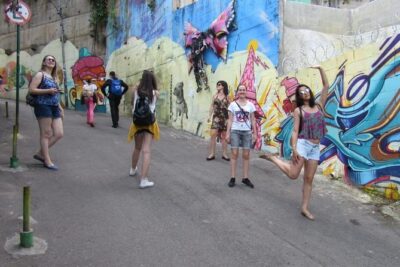
- Santa Teresa: a bohemian neighborhood with winding streets, colonial mansions, and art studios
- Escadaria Selaron: the famous colorful mosaic staircase created by artist Jorge Selarão, a photo stop with real personality
These stops matter because they show a side of Rio that you cannot get from viewpoints alone. You get texture, street art, and that feeling of walking through layers of creative life.
Wear shoes you can trust on uneven pavement. These neighborhoods are charming, but the ground is not always flat.
Maracana and the Sambadrome: sport and Carnival in the same day
If your Rio priority includes sport, you want Maracana. It is an iconic football stadium that has hosted two FIFA World Cup finals, and it represents Brazilian football passion in a way that no museum exhibit can fully replicate.
Then there is the Carnival side of Rio with Sambadromo da Marques de Sapucai, designed by Oscar Niemeyer. This is the heart of the Carnival parade, and it is a unique venue dedicated to samba competitions and festivities.
These two stops are valuable because they connect Rio’s public energy across seasons. Football Saturdays and Carnival parades share the same cultural DNA: music, identity, and crowds that feel personal rather than anonymous.
Entrance for these can be ticketed, so plan for extra costs where applicable. Your guide can help you decide what timing is realistic so you do not end up rushing.
Mirante Dona Marta and Christ the Redeemer: build your day around clear views
This is the part of the tour where your planning really pays off. The route includes Corcovado and Christ the Redeemer, one of the New Seven Wonders of the World. The views from Corcovado are the reason you come to Rio in the first place.
Christ tickets are not included on this tour. That matters because lines and timing can affect your whole schedule. If your heart is set on seeing Christ without stress, plan an early approach and let your guide handle the timing strategy.
There is also a built-in “weather happens” option: Mirante Dona Marta, a scenic lookout that can deliver strong panoramic views of Rio, including Sugarloaf and Christ. People have used this viewpoint as a smart alternative when visibility is poor, so ask your guide how they plan for fog or cloudy conditions on your date.
In other words, do not treat Christ as a single moment. Treat it as a view problem your guide can help you solve.
Museu, memorials, and waterfront architecture: MAR and Museu do Amanhã
If your route runs toward the waterfront, you might include:
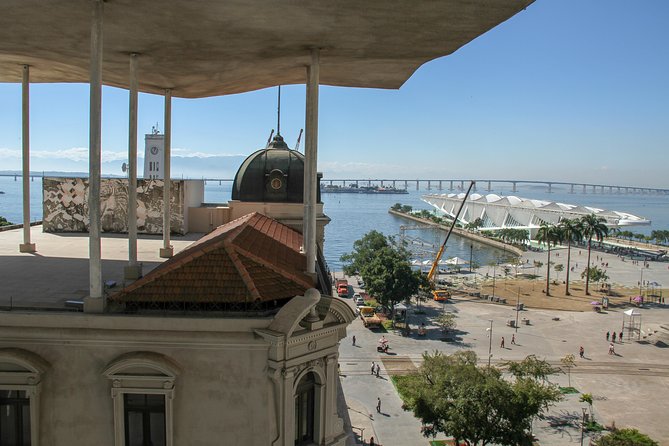
- Museu de Arte do Rio (MAR) in Praça Mauá, blending historic and modern architecture and exploring Rio’s art, history, and social evolution
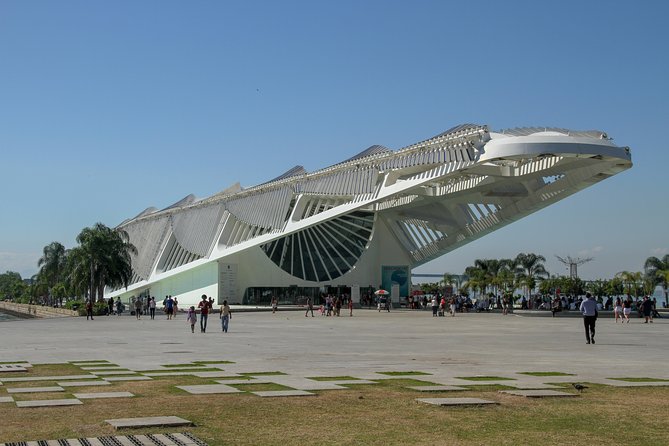
- Museu do Amanhã, a futuristic science museum focused on sustainability and innovation, designed by Santiago Calatrava
You can also add Museu de Arte Contemporanea de Niteroi, designed by Oscar Niemeyer. The saucer-shaped museum overlooks Guanabara Bay, with rotating contemporary art exhibitions.
These stops are a nice counterweight to the outdoor viewpoints. They are also an easy way to understand Rio beyond its photos. Instead of only focusing on what is famous, you get a clearer sense of what Rio is thinking about, building, and discussing.
Plan for paid admissions where the route lists ticketed entry, especially for the museums marked as not included.
Petropolis portal and Rio’s civic landmarks: where a day gets surprising
The itinerary can also include Portal de Entrada de Petropolis, a gateway to the mountain city of Petrópolis. It is a good “breather” moment that reminds you Rio is close to a whole other climate and feel.
Civic architecture can show up too, such as:
- Tiradentes Palace, the state legislative assembly with grand architecture and murals tied to Brazil’s political history
- Palacio Pedro Ernesto and Camara Municipal, housing Rio’s municipal chamber in elegant neoclassical style
These stops are not there to impress you with marble. They help you understand how the city organizes power and public life, and why certain areas feel the way they do today.
What to budget for, plus practical packing tips that actually help
Entrance fees and ticket admissions are at your own expense, even though some stops on the route are free. The biggest paid categories to expect are for major attractions like Sugarloaf and Christ the Redeemer, plus selected museums on the day.
Food and drinks are also not included, so do not assume you will be fed. Rio heat can be intense, so I recommend you pack a small day bag with water, sunscreen, and a hat.
If you want the best day, think like this:
- Wear shoes built for lots of short walks and uneven pavement.
- Keep a flexible mindset. If fog or clouds blur viewpoints, your guide can reroute toward another lookout like Mirante Dona Marta.
- Bring a little patience for popular sites. A private guide helps, but you still share the city with reality.
How the guide and driver make or break the experience
The tour is built around a certified multilingual guide and driver, plus a private vehicle. That means your day depends less on luck and more on how your guide uses the time.
In the real world, what makes these trips feel smooth is the combination of:
- Clear communication before you go, so your itinerary matches your priorities
- Timing decisions that prevent you from repeating routes or arriving when it is worst to be outside
- Practical suggestions that go beyond the obvious list
You will also notice a common thread in how different guides run the day. People have credited guides such as Victoria, Ederson, Niels, Gabo, and Vincente for creating a plan that matches the family or couple’s pace, sometimes adjusting around weather and queue realities. If your guide offers options, take them. If they suggest starting early for Corcovado views, listen.
A private day is also one where small needs get handled. If someone in your group needs extra breaks or fewer steps, you can ask.
Should you book this private Best of Rio tour?
Book it if you want a single-day Rio overview that you can shape. It is great for first-timers who want the icons, for active couples who still want museums and culture, and for families who benefit from hotel pickup and someone managing timing.
Skip it or rethink it if you want a fully self-directed trip. This is a guided, structured day, and the value comes from the routing decisions and the access to paid attractions like Sugarloaf and Christ.
If you book, do one thing that will make your day better: before you go, send your guide a clear priority list. For example, tell them if you want beaches first, if you care about Carnival venues, or if you want more nature time at Tijuca. With a private plan, that list becomes your itinerary magic.
FAQ
How long is the tour?
It runs about 8 hours.
What time does the tour start?
The start time is 8:00 am.
Where does the tour pick up and drop off?
Hotel pickup and drop-off are included, and the tour ends with drop-off at your Rio de Janeiro hotel.
Is this a private tour or shared with others?
It is private. Only your group participates.
Are entrance tickets included?
Ticket entrances are not included. Some stops are listed as free, but paid attractions and museums are at your own expense.
Can I get a full refund if I cancel?
Yes. Free cancellation is available if you cancel at least 24 hours before the experience’s start time for a full refund.
Newest Rio de Janeiro reviews
- Maracanã Matchday Tour – Ticket + Guide + Transfer★ 5.0 · 14 reviews
- Angra & Ilha Grande From Rio: Boat Tour With Barbecue and Drinks★ 5.0 · 14 reviews
- Private Tour with Churrasco in Vela Catamaran – Velas do Rio★ 5.0 · 14 reviews
- Half-Day Private Tour:Rio de Janeiro Highlights by Bernard Moraes★ 5.0 · 14 reviews
- Tijuca Forest Adventure★ 4.5 · 14 reviews
- Rio de Janeiro: Join a Fluminense game at Maracanã with locals★ 5.0 · 15 reviews
- Rio de Janeiro: Join a Botafogo soccer game with transport★ 5.0 · 15 reviews
- Christ the Redeemer, Selaron Steps and Santa Teresa Half-day Tour★ 4.5 · 15 reviews
Guided, compared.


3 Hour Rocinha Favela Walking Tour with a Local Guide
Read our review →

Jeep Adventure: Guided Tour through Tijuca Rain Forest
Read our review →Jeep Adventure: Guided Tour through Tijuca Rain Forest
Read our review →

Guided Expedition with Canoeing and Waterfalls in Iguaçu
Read our review →