
Reviewed · RECIFE & OLINDA
Jewish Tour Recife and Olinda Jewish Presence SEC XVI, XVII and XX
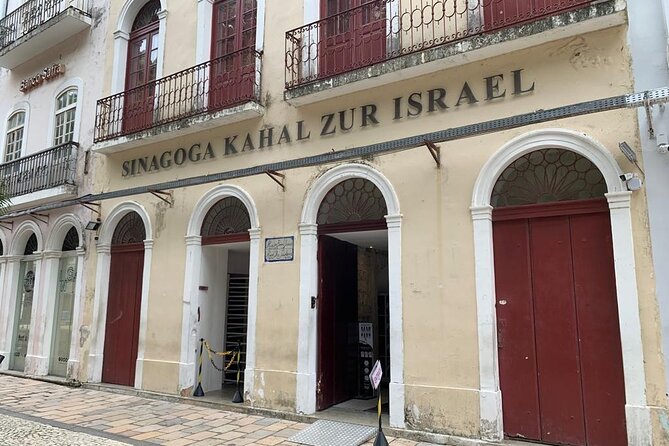
Jewish presence in Recife and Olinda is one of those stories you can actually walk through, not just read about. You move from everyday street corners and old building sites to the Kahal Zur Israel synagogue, with the guide tying each stop to a different century of the community. I love the street-level landmarks like Rua da Imperatriz and Good Jesus Street, because they help you picture trade, daily life, and where people actually moved. I also love the human, guide-led storytelling, with historians like Jader (Portuguese) and Victor (with in-depth synagogue context) making the details feel personal instead of academic.
One thing to consider: the tour depends on good weather, and the synagogue has an extra admission fee. Also, language support can vary by guide setup, so if you need English throughout, it’s worth confirming how your bilingual historian will work with your group.
Key highlights worth knowing
- Three-century route connecting 16th, 17th, and 20th-century Jewish presence across Recife and Olinda
- Kahal Zur Israel synagogue visit with structured historical context during a 1-hour stop
- Old town stops with specific locations, including Praça Maciel Pinheiro and Rua da Imperatriz
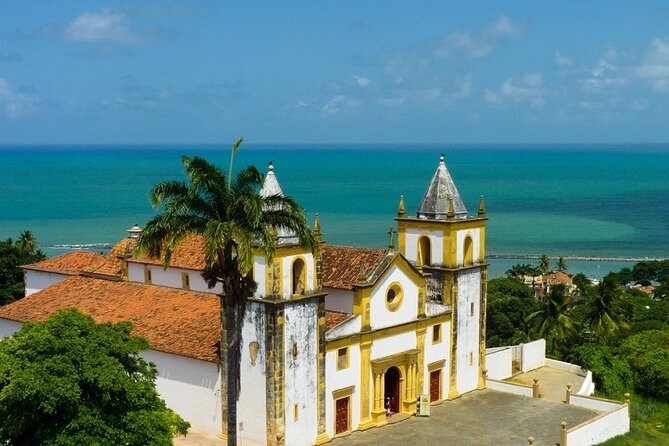
- Olinda landmark sites tied to Jewish community memory, including the assumed mikve at House of Branca Dias
- Comfortable logistics for a half-day, including hotel pickup and an air-conditioned vehicle
- Flexible pacing so you can slow down for photos and side looks when your guide allows
Why this Recife and Olinda Jewish route feels different from a standard tour
Recife and Olinda can look like normal Brazilian cities if you show up with no context. This tour flips that. Suddenly Rua da Imperatriz is not just a road, it is described as the principal artery where Jewish trade concentrated, and you start seeing the city as a map of people moving, working, worshipping, and later being displaced or pressured.
What makes it especially compelling is the way the story is organized by time periods. You get a guided framework for what to look for, so the day doesn’t become random sightseeing. You’re not just taking photos of old churches, you’re learning why specific places mattered to Jewish life in each era.
The other big plus is that you are not stuck in a museum room. You are traveling between neighborhoods, crossing key areas like the famous bridge tied to a Jewish engineer, and then spending time on Olinda’s historic sites. That combination helps your brain connect dots fast, and it also makes the emotional parts land.
More of Recife and Olinda:
- Private Transport from Recife to Porto de Galinhas
★ 5.0 · 143 reviews - Private Transfer from Recife Airport to Maragogi
★ 4.0 · 63 reviews - Recife & Olinda City Tour: Unveiling the Charm of Two Cities
★ 3.9 · 51 reviews
Price and value: what $235.43 really buys you
At $235.43 per person for roughly 5 to 6 hours, this is not the cheapest way to tour Recife and Olinda. But it is also not priced like a big-city prestige experience. For the money, you get a private tour setup, plus private transportation in an air-conditioned vehicle.
You also get more than one guide type. The included setup lists a bilingual guide and a historian guide, which matters because local history stories get better when the person explaining them has context, not just a script. In practice, that’s how you end up with the kind of explanation that helps you understand the synagogue’s background and the older street sites you pass along the way.
Most stop locations include admission tickets during the day, but one major exception stands out. The Kahal Zur Israel synagogue admission is listed as R$50.00 per person and is not included. So if you budget for food and photos and you also plan to cover the synagogue ticket, the cost picture feels clear instead of surprising.
If you want a tour that is mostly driving plus a quick photo stop, this probably will not feel like good value. This one builds in time at multiple locations, including a full 1-hour block for the synagogue visit and an additional hour and half in Olinda’s key sites. You pay for time, explanation, and the guide’s ability to connect places across the region.
Timing, pickup, and weather: how to plan your half-day
This tour runs in the morning window, with opening hours listed as 6:00 AM to 10:00 AM. That matters because a day that depends on good weather in a coastal region can get uncomfortable fast if the sky is heavy or rainy. If you’re the type who hates rushing, it’s best to arrive rested and ready rather than showing up late and hoping the schedule magically adapts.
Pickup is offered from hotels, airports, and ports. The operator also says you can enter your departure and return location, which is useful if you are staying outside the city core or arriving by cruise. For a half-day experience, smooth pickup reduces the usual stress of “where do we meet” and “how do we get there on our own.”
Confirmation is stated as within 48 hours of booking, subject to availability. And if weather cancels, you’ll be offered another date or a full refund. The practical takeaway: don’t treat this as a “maybe we’ll go” plan. If you see a forecast turning for the worse, start mentally preparing for a change.
Stop by stop in Recife: Praça Maciel Pinheiro to the old trading streets
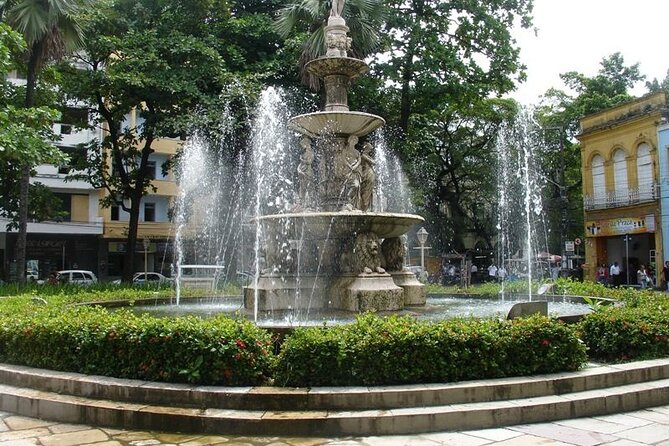
Your first key anchor point is Praça Maciel Pinheiro. This is presented as a meeting place for the Judaic community, so it is a strong way to start: you begin with the idea of community organization before you move into streets and buildings. You also get a short stop duration, about 15 minutes, so you’re not dragged around before the story even starts.
From there, the day shifts into the neighborhood street web. You pass the former Jewish street area connected to Bom Jesus Street, and then you move toward Rua Beija Flor and Rua da Imperatriz, described as the principal road where Jewish trade was concentrated. I like this part because it forces you to notice how commerce shapes geography. Trade routes tend to leave traces, even when the people are gone.
Expect small time slices for each location rather than one long uninterrupted walk. That’s a feature, not a bug, because the tour is trying to keep the time periods organized while you travel between Recife and Olinda. If you prefer a slow walking tour with fewer transfers, this structure might feel brisk, but you will still get meaningful context at each stop.
Another Recife neighborhood stop is Brasília Teimosa, also described alongside Praia do Pina. This is framed as a place of Jewish people, which turns the idea of “neighborhood memory” into something you can point at. Instead of treating Jewish presence like an abstract chapter of the past, you’re shown where daily life may have concentrated.
A few more Recife options
- Boa Viagem or Piedade: Olinda and Recife Antigo Day Trip
★ 3.9 · 31 reviews - From Recife : Carneiros Beach
★ 4.3 · 27 reviews - City Tour of Olinda Including Instituto Ricardo Brennand
★ 4.5 · 26 reviews - Recife & Olinda Highlights
★ 5.0 · 16 reviews
The Kahal Zur Israel synagogue visit: the day’s historical engine

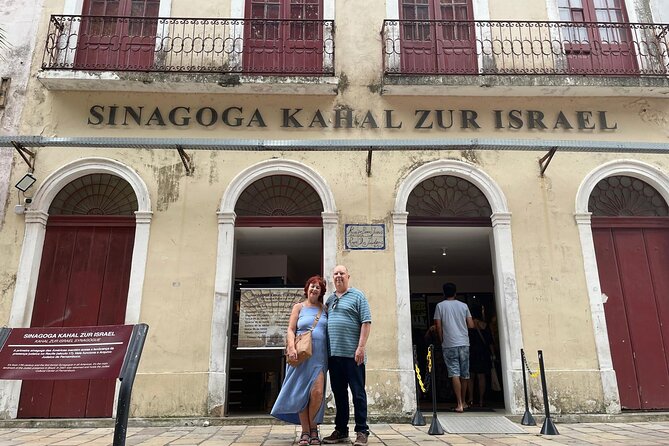
The main moment is the Kahal Zur Israel Synagogue stop, listed at 1 hour, with admission included in the tour details for that specific section, but also marked as an extra R$50.00 per person outside the included items. Either way, you should plan time and money for the synagogue admission.
What I find most valuable here is the way the guide organizes what you’re seeing. The synagogue stop is described as a guided route through historic Jewish presence in Recife and Olinda, laid out in three blocks.
- First block (20th century): Plaza Maciel Pinheiro, Rua da Imperatriz, and Rua Martins Junior where a synagogue of Recife is referenced
- Second block (17th century): Brasilia Teimosa, Good Jesus Street as an ancient Judens street, and the synagogue itself described as the first of the America
- Third block (16th century): Olinda’s principal nucleus, an assumed mikve at White House Days, and Igreja da Sé described as a place of denunciation of New Christians
You don’t have to love every historical detail to benefit. The value is that you learn what to watch for as you go, and you understand why the guide keeps pointing out certain streets, not random corners. It also gives you language to connect Recife and Olinda without feeling lost.
Language can also matter at this stage. One set of experience notes describes a historian, Jader, speaking Portuguese with translation provided by Roseane. Another highlights Victor as very personable and detail-focused. Either way, the practical advice is simple: ask questions when you can. If your guide is moving through a structured narrative, your questions will usually plug right into it.
Olinda’s “church sites” that the tour frames as Jewish memory
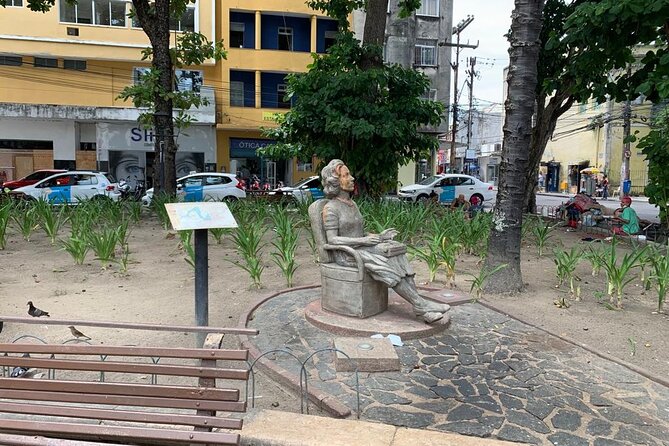
Olinda is where the story becomes more layered, because you are often looking at churches or church-linked sites through a Jewish presence lens. The tour’s key Olinda stops include time at three different locations, all framed as connected to earlier Jewish community life.
First is the “house of Jewish guards” at a current church, with about 1 hour on site. This is one of those places where you will probably want the guide to keep talking, because without context, many visitors would simply see another historic church. With the route explained, you start seeing how institutions and neighborhoods change over time.
Next is the House of Branca Dias, listed as an assumed mikve stop, with 30 minutes. The key word here is assumed, which matters. It means the tour is pointing you toward a specific memory tied to Jewish life, even if the certainty level is not stated as absolute. I appreciate that the framing does not pretend to be more definitive than it is, and it gives you a chance to consider what evidence might support the idea.
Then you move to Igreja da Sé, described as the local of denunciation of New Christians, with another 30 minutes. This is an emotionally heavy theme, and the way it is presented during the day can shape how the Olinda sites feel. If you’re sensitive to difficult histories, give yourself a slower pace for photos and take breaks as needed.
In short, Olinda turns the tour from “history of a community” into “history that left marks on buildings and city logic.” You come away with a new way to read old stone, not just old facades.
Mauritius Bridge of Nassau and the engineer angle that many people miss
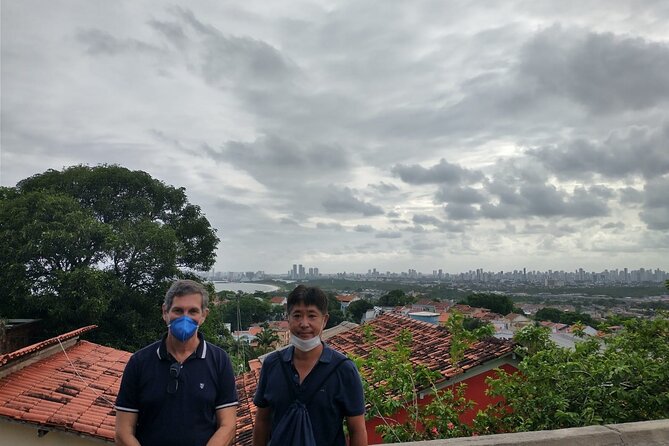
Between Recife and Olinda, the tour includes the Mauritius Bridge of Nassau, described as the first bridge in the city by the Jewish engineer Baltazar Fonseca. I like this part because it shifts the story away from only religious spaces. Engineers, builders, and infrastructure often get overlooked, yet they show how a community contributes to the practical workings of a place.
This is also where you get a natural transition. You’re moving from Recife neighborhoods tied to trade and settlement, into Olinda’s historic core and its institutional sites. The bridge becomes a timeline marker, a physical reminder that Jewish presence is not only about synagogues, it is also about shaping the city’s movement.
If you’re the type who enjoys “how did people live and build,” this detail will make the day stick. It’s one of those small anchoring facts that keeps the story from feeling like disconnected postcards.
Recife Antigo memorial: closing the loop in 25 minutes
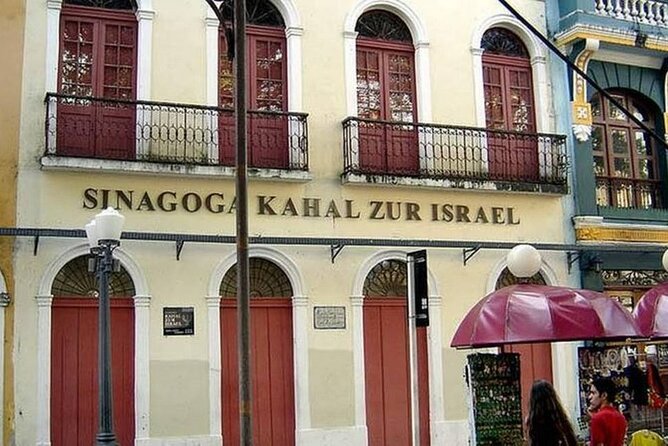
The final stop is Recife Antigo, at a memorial honoring Jewish history in Recife, listed at 25 minutes with an admission ticket included. A memorial stop is not automatically satisfying, because some memorials feel generic if you don’t have context. Here, the rest of the tour gives you that context, so the memorial starts to make sense as a summary point rather than a random ending.
By the time you reach this, you have already visited the neighborhoods, the street-level trade references, the synagogue framework, and the Olinda church-linked sites. So the memorial feels like a “put it all on one page” moment, especially if your guide has been steering you to remember names and locations.
This closing timing is also practical. You still have enough energy after 5 to 6 hours to head for food or wander a bit on your own. You’re not stuck at the end of the day waiting for an extra long final stop.
What you’ll likely enjoy most, based on how the guides work
This experience seems to succeed when the guide is doing two jobs at once: explaining the history and keeping the pace comfortable. The descriptions of guides like Victor highlight that he focuses on comfort and depth around the synagogue, not just quick answers. Another guide setup includes Jader’s Portuguese delivery with translation from Roseane, which shows how the tour handles language needs without making the experience feel shut down.
Flexibility also comes up. One practical note is that the guides are amenable if you want to stop to look at other sights along the way. That is a big deal on a tour like this, because street corners and weather and curiosity all affect how the day feels in real time.
So if you like your tours to feel human and adjustable, this is a good fit. If you prefer a strict clock with zero variation, any ability to pause for extra looks might feel like an unpredictability tax. Either way, the structure is still there, especially around the synagogue and the Olinda time blocks.
Who should book this tour, and who might skip it
Book it if you want Jewish history in Recife and Olinda that connects to specific places, with a guide explaining how the story shifts across centuries. This works especially well if you enjoy walking city streets with purpose, and if you like history that includes geography, not just dates.
It also fits well if you like having a local historian at the center of the day. The included historian guide setup is designed for that kind of learning, and it’s usually the difference between “I saw a synagogue” and “I understood why this synagogue matters and how it connects to Olinda.”
Consider skipping if you’re expecting a relaxed, minimal-guidance photo outing. This is structured and narrative-driven, with multiple stops and time blocks. And since weather affects the tour, you also need to be okay with the possibility of a change if the day turns rainy or unpleasant.
Most travelers can participate, and the tour includes private transportation, which helps. But it is still a city day, with some walking and standing, so wear shoes that handle uneven sidewalks and sun.
Practical tips to make the day go smoothly
Bring a light layer if you get morning wind, and plan for sun. Recife can feel bright even when clouds move through, and you’ll be outside at several stops.
If you need consistent English, check the bilingual guide arrangement when you confirm. In at least one setup, the historian is described as speaking Portuguese with translation, which suggests the team structure can flex. You want to make sure your guide pairing works for your language needs.
Budget for the synagogue admission fee listed as R$50.00 per person, even if your tour details mention ticket inclusions for the synagogue section. You do not want to end the day dealing with last-minute payments.
Finally, bring curiosity. When your guide points out Rua da Imperatriz as a trade concentration, Good Jesus Street as an ancient Judens street, or Igreja da Sé as connected to denunciation themes, ask what stood out and why that place is singled out. You’ll get more from the day if you treat it like a conversation, not a lecture.
Should you book this Jewish presence tour of Recife and Olinda?
I think you should book if you want a guided, place-based history day that connects Recife and Olinda through multiple time periods, with a synagogue visit that actually explains what you’re seeing. The private transportation, air-conditioned comfort, and historian-led storytelling make it feel worth the money, especially given the number of stops and the time spent at the major sites.
Skip it if your top priority is a free-form self-guided wander, or if you hate any chance of the schedule being affected by weather. Also think twice if you dislike historical themes tied to denunciation or the pressures placed on New Christians, since the Igreja da Sé framing brings that theme into the open.
If you want a thoughtful, organized half-day with city context and emotional weight, this is a strong choice.
FAQ
How long is the Jewish Recife and Olinda presence tour?
It lasts about 5 to 6 hours.
What does the tour cost?
The price is $235.43 per person.
Is hotel pickup included?
Yes. Pickup is offered from hotels, airports, and ports, using an air-conditioned vehicle.
Is this a private tour?
Yes. It is private, meaning only your group participates.
What language is the tour offered in?
The tour is offered in English.
Are tickets included?
Admission tickets are included for several stops, but the Kahal Zur Israel Synagogue admission fee is listed separately at R$50.00 per person.
What time does the tour operate?
The listed opening hours are Monday through Sunday, 6:00 AM to 10:00 AM.
What happens if the weather is poor?
If it is canceled due to poor weather, you will be offered a different date or a full refund.
When do I get confirmation after booking?
Confirmation is received within 48 hours of booking, subject to availability.
Newest Recife reviews
- Transfer Cabo de Santo Agostinho Recife Airport For 4 People Private.★ 3.5 · 3 reviews
- Day Trip to Porto de Galinhas from Recife★ 5.0 · 3 reviews
- Shopping Tour in Recife★ 4.5 · 4 reviews
- Private Transfer from Recife Airport to Tamandaré★ 3.5 · 5 reviews
- Private Transfer from Recife to Maragogi 01 to 06 Pax by Geotur Receptives★ 5.0 · 5 reviews
- Transfer Airport DE Recife/Port DE Galinhas (turn or return)★ 5.0 · 6 reviews
- Private Transfer from Recife Airport to Serrambi By RECIFE TRANSLADO★ 5.0 · 7 reviews
- Arrival Transfer from Recife Airport to Porto de Galinhas★ 4.5 · 9 reviews
Recife & Olinda, compared.
Private Transport from Recife to Porto de Galinhas
Read our review →
Private Transfer from Recife Airport to Maragogi
Read our review →
Recife & Olinda City Tour: Unveiling the Charm of Two Cities
Read our review →
Private Transfer from Porto de Galinhas to Recife Airport
Read our review →
Boa Viagem or Piedade: Olinda and Recife Antigo Day Trip
Read our review →

City Tour of Olinda Including Instituto Ricardo Brennand
Read our review →
Browse the lists this tour appears in